

1. What Is Volatility in Casino Games?
Casino-game volatility describes the spread and concentration of possible returns. It helps explain whether a game’s theoretical payout is built from many smaller results, a mixture of small and large results, or a smaller number of highly valuable outcomes.
The term is especially common in online slots, but the underlying idea applies to many online casino games. An even-money roulette bet and a straight-up number bet can have the same house edge while producing dramatically different result patterns. A blackjack hand, baccarat side bet, live game show and progressive jackpot can also carry different levels of short-term variation.
Volatility describes a distribution, not a prediction
A high-volatility label does not mean the next spin will lose, and a low-volatility label does not mean the next spin will return part of the stake. The label summarizes the overall mathematical profile. Individual rounds remain governed by the game’s rules and random or physical outcome process.
There is no universal low, medium or high threshold
Providers can use different internal scales and labels. One studio may classify a game as medium-high while another would call a similar mathematical profile high. Some games publish a numeric volatility index, while others show only a descriptive rating—or no rating at all.
Because there is no single industry-wide cutoff, volatility labels are most reliable when comparing titles within the same provider’s catalog. Do not assume that every “medium” game has the same probability distribution.
2. Volatility, Variance and Standard Deviation
Casino articles commonly use volatility and variance as interchangeable terms. They are closely related, but they are not mathematically identical.
| Term | Technical or practical meaning | How players usually see it |
|---|---|---|
| Expected return | The probability-weighted average return of all possible outcomes. | Usually expressed as RTP. |
| Variance | The probability-weighted average of squared differences from the expected return. | Rarely displayed directly in a game interface. |
| Standard deviation | The square root of variance, expressed on the same scale as the measured return. | Sometimes used in technical game documentation. |
| Volatility rating | A simplified description of the width and shape of the payout distribution. | Low, medium, high or a provider-specific index. |
For an outcome return X with average return μ, variance can be summarized as:
Variance = Σ probability × (outcome return − average return)²
The squaring step gives greater weight to results far from the average. That is why a small probability of a very large multiplier can substantially increase variance even when the game’s RTP stays unchanged.
3. Low, Medium and High Volatility Casino Games
The three labels describe broad profiles, not promises. They are useful for comparing the pace and size of potential swings, but they do not reveal the result of a session.
| Profile | Typical distribution | Possible session behavior | Important limitation |
|---|---|---|---|
| Lower volatility | More probability concentrated in smaller returns. | Often produces tighter balance movement at equal stakes. | Can still produce losing sequences and does not guarantee a longer session. |
| Medium volatility | A broader mixture of small, medium and occasional larger returns. | Can alternate between ordinary payouts and more valuable features. | “Medium” has no universal provider-independent definition. |
| Higher volatility | More theoretical value concentrated in rare, larger outcomes. | Can create longer dry periods and sharper balance changes. | A larger potential payout is not more likely simply because the game is high volatility. |
Low volatility
A lower-volatility game generally produces a narrower return distribution. Smaller prizes or partial returns may appear more often, while extreme outcomes contribute less to the overall model. The Fortune Gems game review shows a compact fixed-payline and multiplier-reel format often discussed as a lower-to-moderate variance example. Verify the active provider classification rather than treating a third-party label as universal.
Medium volatility
A medium-volatility profile generally mixes ordinary returns with less frequent higher-value outcomes. The Super Ace game review explains cascades, Golden Card transformations and a rising multiplier sequence. Those mechanics widen the range of possible round results, but the provider’s current information panel remains the best source for the official rating.
High volatility
A higher-volatility game generally allocates more value to rare bonus rounds, multipliers or top prizes. The Gates of Olympus game review covers random multiplier symbols, while the Sweet Bonanza 1000 game review explains multiplier bombs and a large maximum-win model. These are useful mechanical signals, but they do not replace a published volatility specification.

4. RTP vs Volatility: What Is the Difference?
Return to Player describes the theoretical average amount returned across a very large number of qualifying wagers. Volatility describes how widely individual results are distributed around that average.
| Question | RTP answers | Volatility answers |
|---|---|---|
| What does it measure? | Expected long-run return. | Spread and concentration of possible outcomes. |
| Does it predict one round? | No. | No. |
| Can two games share the same value? | Yes, two games can have the same RTP. | They can still have very different volatility. |
| What should be checked? | The active game’s percentage and configuration. | The provider rating, payout distribution and feature structure. |
The complete online casino game RTP guide explains theoretical return, house edge and wagering turnover in more detail. These metrics should be read together rather than used as substitutes for one another.
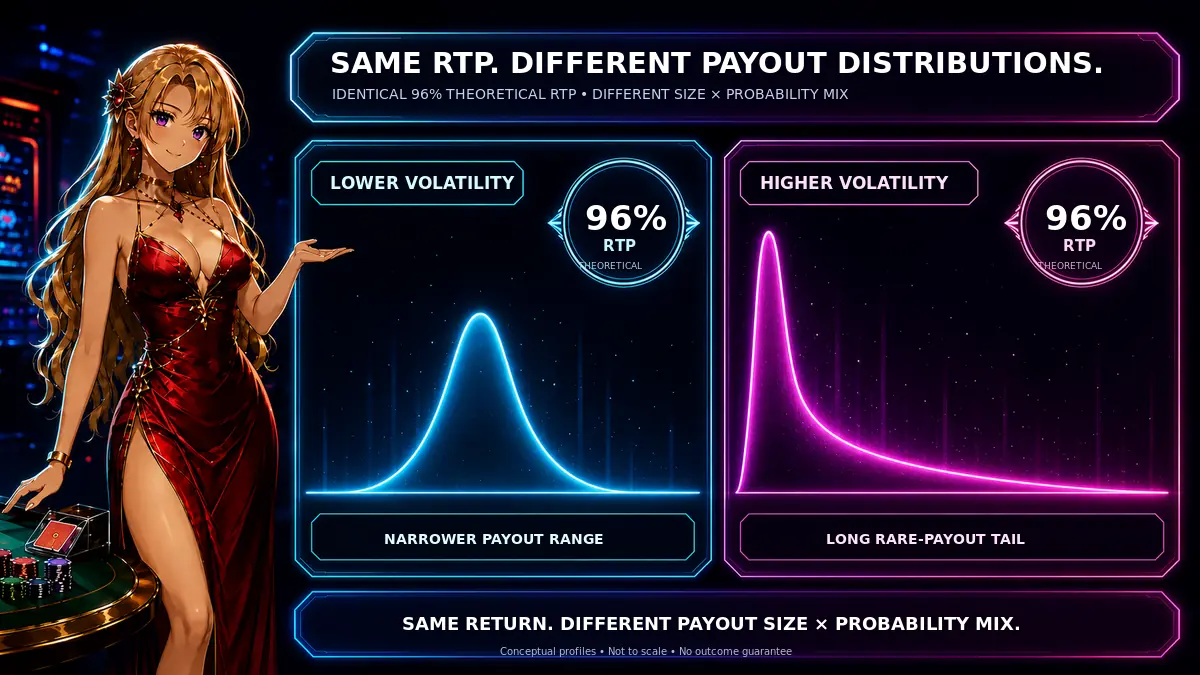
5. Worked Example: Same RTP, Different Payout Distribution
The fictional one-credit games below both have 96% theoretical RTP. Their result patterns are intentionally simplified to show how the same average can be created in very different ways. Payout multiples include the total amount returned.
| Outcome | Lower-volatility example | RTP contribution | Higher-volatility example | RTP contribution |
|---|---|---|---|---|
| 0× return | 30% probability | 0.00 | 90% probability | 0.00 |
| 0.5× return | 40% probability | 0.20 | — | — |
| 1× return | 25% probability | 0.25 | 5% probability | 0.05 |
| 5× return | — | — | 4% probability | 0.20 |
| 10.2× return | 5% probability | 0.51 | — | — |
| 71× return | — | — | 1% probability | 0.71 |
| Total expected return | 100% probability | 0.96 or 96% | 100% probability | 0.96 or 96% |
The lower-volatility example returns something on 70% of rounds, although many of those returns do not exceed the stake. The higher-volatility example returns something on only 10% of rounds, with most of its expected value concentrated in the rare 71× outcome. Both still have the same 96% RTP.
6. Volatility vs Hit Frequency
Hit frequency is the expected percentage of rounds that produce a result classified as a hit under the provider’s definition. It is related to payout distribution, but it does not measure the size or profitability of those hits.
A ₱10 spin that returns ₱3 may count as a hit even though the player has a net loss of ₱7. A 1× return may return the stake without creating a profit. Some providers also count feature triggers differently, so published hit-frequency figures are not always directly comparable.
| Result on a ₱10 stake | May count as a hit? | Net result |
|---|---|---|
| ₱0 returned | No | −₱10 |
| ₱3 returned | Yes, depending on the definition | −₱7 |
| ₱10 returned | Yes | ₱0 |
| ₱25 returned | Yes | +₱15 |
A high hit frequency can coexist with a house edge because many counted hits may return less than or equal to the amount staked. Always distinguish between a nonzero payout, a stake return and a profitable result.

7. How Slot Mechanics Affect Volatility
A game’s theme and graphics do not determine its risk profile. Volatility comes from the probability and value assigned to its possible outcomes. Certain mechanics can signal a wider distribution, but no single feature proves that a title is high volatility.
| Game mechanic | How it may affect the distribution | Why it is not enough by itself |
|---|---|---|
| Cascades or tumbles | Can chain several evaluated results within one paid round. | Probability weights and pay values determine the overall effect. |
| Random multipliers | Can create a wider range between ordinary and top outcomes. | Small multipliers may occur more often than large ones. |
| Free spins | Can concentrate part of the RTP in less frequent bonus events. | Trigger rate and bonus distribution vary by game. |
| Progressive jackpots | Can place a small share of expected return in an extremely rare prize. | The jackpot may be only one component of total RTP. |
| Bonus buys | Provide direct access to a high-variance feature for a larger stake. | A feature purchase does not guarantee a payout equal to its cost. |
| Large maximum win | Shows that a far-right payout outcome exists. | Does not reveal the probability assigned to that outcome. |
Pragmatic Play’s official description of Sweet Bonanza 1000 identifies multiplier bombs up to 1,000× and a maximum win up to 25,000× the bet. Those features help explain the broad range of possible results, but an active game’s own rules and provider rating should still be checked.
8. Volatility Across Different Online Casino Games
Volatility is not limited to slots. It can change between bet types inside the same table game even when the theoretical house edge stays the same.
Roulette example: same RTP, different volatility
On a standard single-zero European roulette wheel, an even-money bet and a straight-up number bet both normally carry a 2.70% house edge. Their payout distributions are very different.
| Bet type | Winning probability | Total return on a win | Theoretical RTP | Relative volatility |
|---|---|---|---|---|
| Even-money red/black bet | 18 out of 37 | 2× stake | 36 ÷ 37, approximately 97.30% | Lower |
| Straight-up single number | 1 out of 37 | 36× stake | 36 ÷ 37, approximately 97.30% | Much higher |
The straight-up bet wins far less often but returns much more when successful. The expected return remains the same because the probability and payout change together. Different roulette variants and special rules can change the underlying RTP.
Blackjack and video poker
Player decisions affect the distribution of results and the effective return. Optional side bets usually have their own probabilities, payouts and volatility. A headline game RTP may assume a particular strategy and may not describe every side bet.
Baccarat
Banker, Player, Tie and side bets have different payout structures. The larger advertised prize on a side bet often comes with a lower hit probability and wider variance.
Live game shows and crash games
Multiplier segments, cash-out decisions and bonus rounds can create highly skewed distributions. Each selectable bet should be evaluated separately rather than assigning one volatility label to the entire interface.
9. Bet Size, Game Speed and Session Balance Swings
Volatility is part of the game’s mathematical profile, while the peso impact depends on the amount wagered. If the stake doubles and the underlying game mode remains the same, the peso value of comparable wins and losses also doubles.
A 20× outcome is ₱200 at a ₱10 stake and ₱1,000 at a ₱50 stake. The payout multiple has not changed, but the balance movement has increased fivefold.
| Outcome | ₱10 stake | ₱20 stake | ₱50 stake |
|---|---|---|---|
| No payout | −₱10 | −₱20 | −₱50 |
| 1× total return | ₱10 returned | ₱20 returned | ₱50 returned |
| 20× total return | ₱200 returned | ₱400 returned | ₱1,000 returned |
Game speed adds another layer. Faster rounds create more wagering turnover in the same period, increasing total exposure to both the house edge and the game’s variance. A lower-volatility label does not guarantee that a fast session will preserve a balance.

10. What Demo Mode Can and Cannot Show About Volatility
Demo mode is useful for learning how an online casino game presents its mechanics. A player can inspect the paytable, observe how cascades work, see what activates a bonus and decide whether the visual pace is comfortable without risking money.
A short demo session cannot reliably measure volatility. Random variation can make a high-volatility game appear active for 20 rounds or make a lower-volatility game appear unusually quiet. A personal sample is also too small to estimate the probability of rare features accurately.
Useful demo-mode checks
- Open the information and paytable screens.
- Confirm the game provider and exact title.
- Look for a published volatility rating or numeric index.
- Understand the cost of each selected mode.
- Observe the mechanics without treating the result sequence as predictive.
The CasinoGameOnline.ph free slot library can be used to learn controls and features. Always check the active game information again if moving from demo to a real-money platform because configurations and regional availability can differ.
11. How to Identify an Online Casino Game’s Volatility
Use explicit provider information before relying on visual clues or a small personal sample.
- Open the game information panel. Search for volatility, variance, risk level or a meter-style rating.
- Check the provider’s documentation. A studio’s own scale is the most relevant comparison for titles in its catalog.
- Review the paytable. Look at the spread between ordinary and top payouts.
- Inspect bonus allocation. Rare free spins, jackpots and multiplier features can widen the distribution.
- Check hit frequency if published. Confirm what the provider counts as a hit.
- Check maximum win with caution. It shows the payout ceiling, not the chance of reaching it.
- Review alternate modes. Bonus buys, ante bets and side bets may use different volatility.
If the provider does not publish a volatility rating, describe the mechanics and available statistics instead of inventing a precise category. A third-party low, medium or high label should be identified as an editorial assessment.
12. How to Compare Casino Games by Volatility
Volatility is most useful as one part of a comparison. It should be read alongside RTP, bet range, game speed, feature rules and any maximum-win cap.
- Compare the active RTP: Games with similar volatility can have different theoretical house edges.
- Compare stakes: The same volatility produces larger peso swings at higher stakes.
- Check game speed: More rounds per hour can create more turnover.
- Review feature concentration: A game may allocate much of its return to a rare bonus.
- Separate hit frequency from profit: Frequent partial returns do not eliminate the house edge.
- Set limits before playing: Do not increase stakes to recover losses or wait for a game to become due.
There is no volatility profile that guarantees longer play, better odds or a profit. The label only helps explain the shape of possible results.
13. Common Casino Volatility Myths
“High volatility means higher RTP”
False. RTP and volatility measure different properties. A high-volatility game can have higher, equal or lower RTP than a low-volatility game.
“Low volatility means the game is safe”
False. A lower-volatility game can still have a house edge and can still produce losing sessions. The label does not remove financial risk.
“A long losing streak means a large payout is due”
False. Previous independent rounds do not force the next one to compensate. Volatility explains the possibility of uneven sequences; it does not make those sequences predictive.
“A large maximum win proves a game is high volatility”
Not by itself. The probability of the maximum result and the rest of the payout distribution also matter.
“High hit frequency means I will profit more often”
Not necessarily. A counted hit may return less than the stake or only return the amount wagered.
“Demo mode reveals the real volatility after a few spins”
A short random sample cannot reliably classify a distribution or estimate rare-feature probabilities.
“Changing the stake changes the game’s volatility”
Changing only the stake usually scales the monetary results without changing the underlying probability distribution. Selecting a different bet mode, side bet or feature can change the mathematics.
“Buying the bonus avoids the dry period”
A bonus purchase provides access to a feature for a larger cost; it does not guarantee that the feature returns its purchase price or produces a profit.
14. Volatility and Online Casino Games in the Philippines
A volatility rating should be checked together with the game rules, active RTP and the status of the operator and domain. A recognizable game provider or a lower-risk label does not prove that the platform hosting it is authorized.
The PAGCOR Electronic Gaming Licensing Department states that PAGCOR regulates games of chance and issues licenses to gaming operations within Philippine territory. Use official PAGCOR information rather than a copied badge, search advertisement or social-media claim.
PAGCOR Responsible Gaming Information states that gambling is for people aged 21 and above and provides support and exclusion information. Understanding variance cannot make a game risk-free or turn gambling into a dependable source of income.
15. Frequently Asked Questions About Casino-Game Volatility
What does volatility mean in an online casino game?
Volatility describes how widely and unevenly possible returns are distributed. Lower volatility generally concentrates more probability in smaller returns, while higher volatility generally concentrates more value in rare larger outcomes.
Are volatility and variance the same?
They are often used interchangeably in casino content. Technically, variance is a mathematical measure of squared deviations from the expected return, while volatility is commonly used as a practical label describing the width of the payout distribution.
What is the difference between RTP and volatility?
RTP measures theoretical long-run return. Volatility measures how widely possible results are distributed around that return. Two games can have the same RTP and different volatility.
Do high-volatility games have a higher RTP?
Not necessarily. RTP and volatility are separate properties. A high-volatility game may have a higher, equal or lower RTP than another game.
Do low-volatility games guarantee longer sessions?
No. They may produce tighter balance movement at equal stakes, but losing sequences, game speed and total wagering turnover can still reduce a balance quickly.
Is hit frequency the same as win probability?
Hit frequency measures rounds classified as hits under the provider’s definition. Some hits may return less than the stake, so hit frequency is not the same as the chance of making a net profit.
Can two games have the same RTP but different volatility?
Yes. One game can produce frequent smaller returns while another concentrates the same theoretical return in rare larger prizes.
Does increasing my stake change volatility?
Increasing only the stake normally scales the monetary results without changing the underlying distribution. Selecting another mode, side bet or bonus feature can change the game mathematics.
Can demo mode accurately measure slot volatility?
A short demo session cannot reliably estimate volatility or rare-event probabilities. Demo mode is better used to learn controls, rules and feature behavior.
How can I find a slot’s official volatility?
Check the information, help or paytable screen inside the active game, then compare it with official provider documentation. If no rating is published, do not invent one from a short result sequence.
Does high volatility mean a large win is due after losses?
No. A losing sequence does not force the next independent round to produce a large win. Volatility describes possible variation, not a repayment schedule.
The Bottom Line
Casino-game volatility describes the shape and spread of possible returns. Lower volatility generally means a tighter distribution; higher volatility generally means more theoretical value is concentrated in rare outcomes. Medium volatility sits somewhere between, but provider labels are not standardized.
Use volatility together with RTP, hit frequency, stake size, game speed and feature rules. It cannot predict the next result or guarantee a suitable session. For the underlying result process, read the complete guide to how online casino games work.
Reference Sources
- eCOGRA — RTP Percentage Testing and Volatility-Based Statistical Evaluation https://ecogra.org/services/rtp-percentage-testing/
- Gaming Laboratories International — iGaming Technical Standards and Game Mathematics Services https://gaminglabs.com/services/igaming/igaming-technical-standards/
- Pragmatic Play — Sweet Bonanza 1000 Mechanics and Maximum Win https://www.pragmaticplay.com/en/news/pragmatic-play-sweetens-up-candyland-in-sweet-bonanza-1000/
- PAGCOR — Electronic Gaming Licensing Department https://www.pagcor.ph/regulatory/cegs.php
- PAGCOR — Responsible Gaming Information https://www.pagcor.ph/regulatory/responsible-gaming.php