
1. What Does Return to Player Mean?
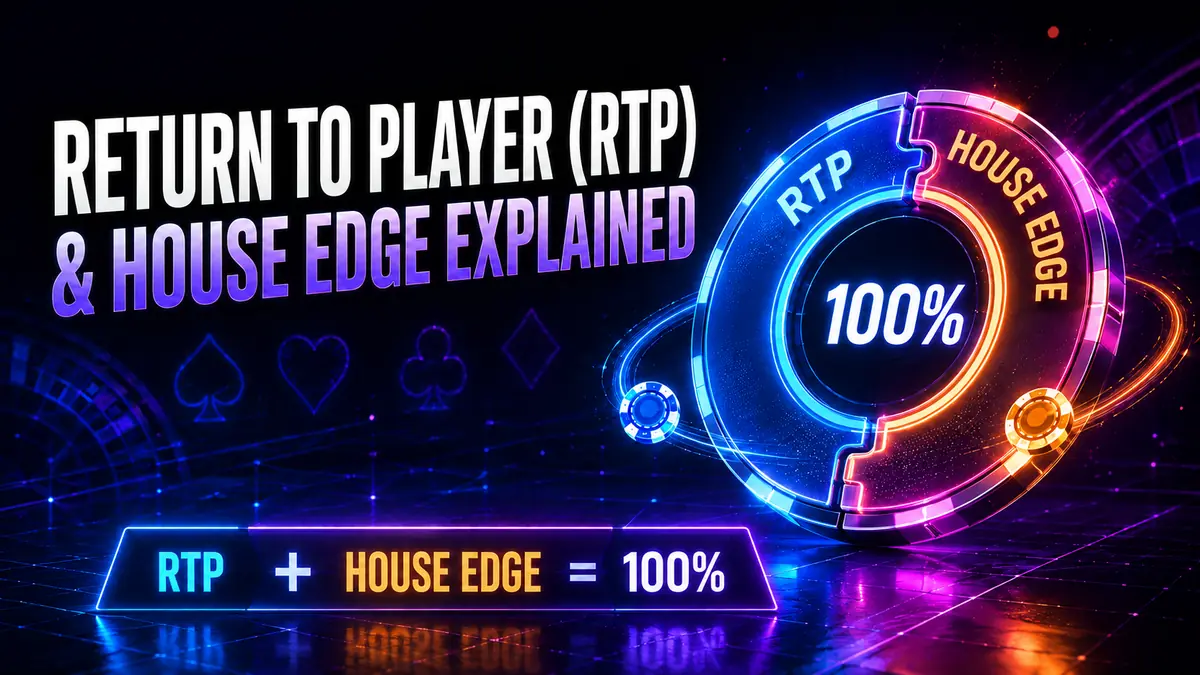
Return to Player is a mathematical expectation. It describes the share of total qualifying stakes that a game is designed to return in prizes over the long run. The remaining percentage is the game’s theoretical house advantage before considering promotions, payment charges or other account-level factors.
Suppose an online casino game has a theoretical RTP of 96.50%. Across the enormous sample used to model and test the game, every ₱100 of qualifying turnover corresponds to an expected ₱96.50 returned and an expected ₱3.50 retained by the house. The calculation applies to aggregated wagering, not to a particular player or a fixed block of rounds.
This is why the common phrase “a 96.50% game gives back ₱96.50 for every ₱100” needs context. It is a teaching shortcut, not a promise. One player could wager ₱100 and lose it all. Another could receive a payout several times larger than the stake. Both outcomes can occur without changing the theoretical RTP.
RTP is not the same as a win rate
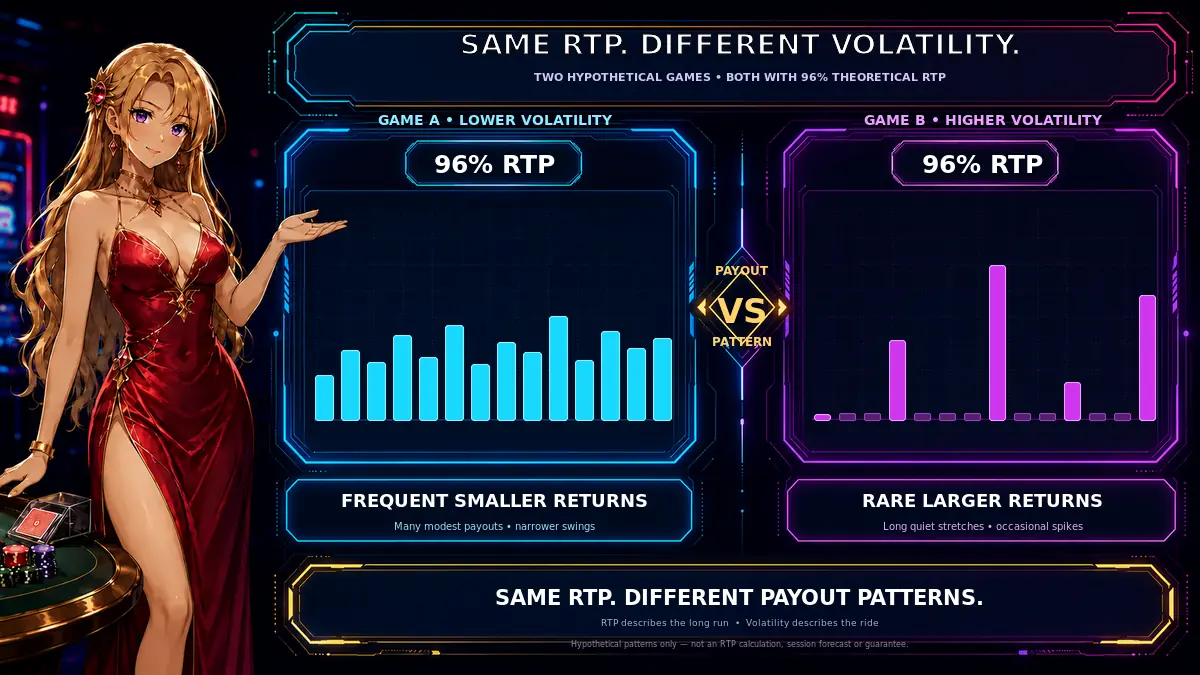
A win rate or hit frequency counts how often a defined winning result occurs. RTP considers the value and probability of all eligible payouts. A game can produce frequent small returns and still have the same RTP as a game with rare large returns.
RTP is not a personal balance target
The game does not normally monitor each player until that person receives the published percentage. RTP is built into the probability and payout model. It does not reset when a player logs in, deposits, changes devices or starts a new session.
Learn more: Why a paytable does not reveal probability by itself
2. How Is Casino-Game RTP Calculated?
At the simplest reporting level, return is expressed as the value of prizes divided by the value of qualifying stakes:
RTP % = (Total Amount Returned ÷ Total Qualifying Amount Wagered) × 100
Game designers calculate theoretical RTP before release by evaluating the probability and payout of every relevant outcome. For a simple game, that may be done through direct mathematical analysis. Complex slots with many reel states, cascades, free spins and jackpots may also require large simulations and specialized testing tools.
A simplified expected-value example
The following fictional one-credit game shows how different possible results can combine into a 96% theoretical return. The payout multiples in this example include the total amount returned.
| Possible Result | Probability | Total Return | Contribution to Expected Return |
|---|---|---|---|
| No payout | 60% | 0× | 0.00 |
| Small return | 20% | 0.5× | 0.10 |
| Medium return | 15% | 2× | 0.30 |
| Large return | 4% | 5× | 0.20 |
| Top return | 1% | 36× | 0.36 |
| Total | 100% | — | 0.96 or 96% RTP |
A real online slot contains a much larger set of possible outcomes. Its model can include symbol weights, paylines or clusters, free spins, multipliers, bonus purchases, progressive jackpots and maximum-win limits. The same expected-value principle still applies.
3. RTP vs House Edge
RTP and house edge express opposite sides of the same theoretical expectation:
House Edge % = 100% − RTP %
| Illustrative RTP | Corresponding House Edge | Expected Theoretical Cost per ₱1,000 Wagered |
|---|---|---|
| 99.00% | 1.00% | ₱10 |
| 98.00% | 2.00% | ₱20 |
| 96.50% | 3.50% | ₱35 |
| 94.00% | 6.00% | ₱60 |
These are expected mathematical costs, not guaranteed losses. A player’s actual result over ₱1,000 of turnover could be a loss of the entire amount, a smaller loss or a profit. The table becomes useful for comparing long-run cost when the stake, game speed and amount wagered are equal.

4. Why Wagering Turnover Is Not the Same as Your Deposit
One of the biggest RTP misunderstandings is applying the percentage only to the first deposit. RTP works against total qualifying turnover: the sum of every stake placed, including money that has already been returned and wagered again.
Consider a player who deposits ₱1,000 and places 100 bets of ₱20. The total turnover is ₱2,000, even if the account never held more than ₱1,000 at once.
Total Turnover = Stake per Round × Number of Rounds
Expected Theoretical Loss = Total Turnover × House Edge %
At a 3.50% house edge, ₱2,000 of turnover has an expected theoretical cost of ₱70. That does not mean the final balance must be ₱930. The actual session can vary widely. The calculation only shows why repeatedly recycling the same balance creates more exposure to the house edge.
| Stake per Round | Rounds | Total Turnover | Expected Cost at 3.50% Edge |
|---|---|---|---|
| ₱10 | 100 | ₱1,000 | ₱35 |
| ₱20 | 100 | ₱2,000 | ₱70 |
| ₱50 | 200 | ₱10,000 | ₱350 |
Game speed matters for the same reason. A fast auto-play session can create much more turnover per hour than a slower table game. A higher RTP does not automatically make the faster session cheaper if the player wagers much more money during the same period.

5. Why Sample Size and Variance Matter
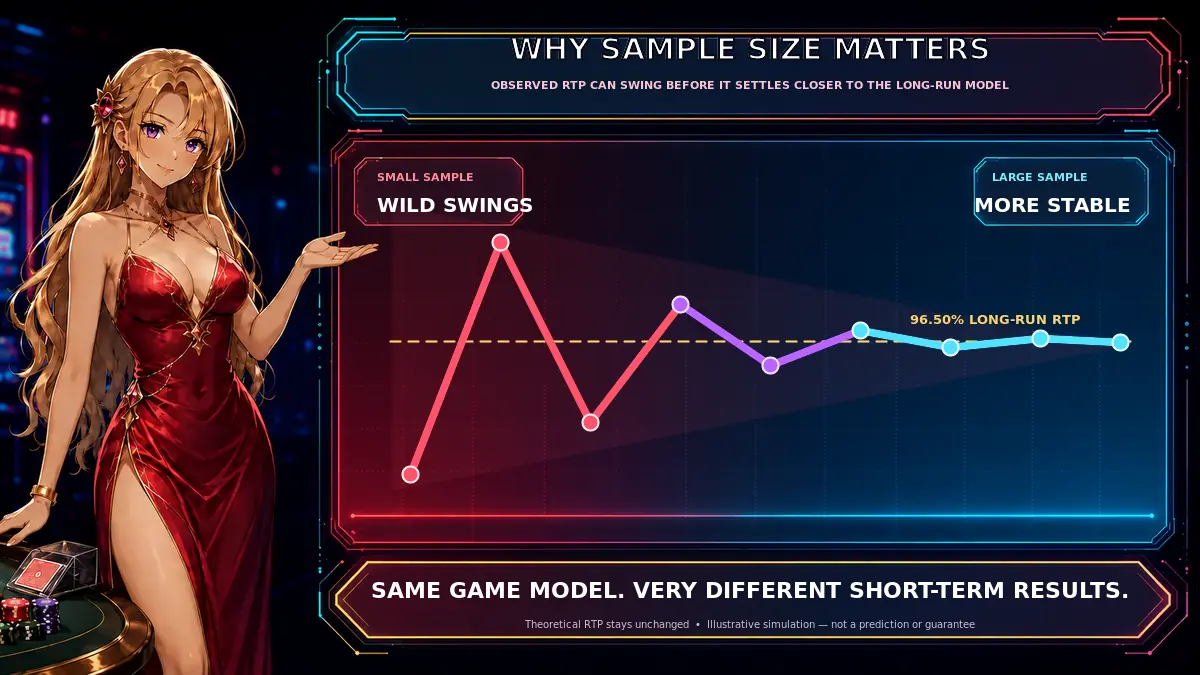
A published RTP is not a schedule that the game must follow every 20, 100 or 1,000 rounds. Random variation can dominate a small sample. A brief session may return nothing, approximately the stake, or several times the amount wagered.
As the number of valid independent trials becomes very large, an aggregate observed return is generally expected to move closer to the theoretical value. This is the principle behind the law of large numbers. It does not specify a magic number of rounds after which every player receives the advertised percentage.
Why “millions of spins” is not a player target
Testing laboratories may use mathematical analysis and very large simulations to evaluate a game. That does not mean a player should attempt to complete millions of rounds. More wagering also creates more total exposure to the house edge. RTP explains long-run game mathematics; it is not a reason to extend a session.
Can a personal RTP tracker prove a game is unfair?
A session tracker can accurately record personal stakes and returns, but a small result far below theoretical RTP is not, by itself, proof that the game is malfunctioning. The probability distribution, volatility and size of the sample must also be considered. Technical complaints should be supported by round IDs, transaction records and the operator’s formal complaint process.
6. RTP vs Volatility and Hit Frequency
RTP measures expected return. It does not describe the path taken to produce that return. Volatility and hit frequency help explain why two games with similar RTP can feel completely different.
| Metric | What It Describes | What It Does Not Tell You |
|---|---|---|
| RTP | Theoretical long-run share of stakes returned as prizes. | The result of one round or session. |
| House Edge | Theoretical long-run share retained by the house. | A guaranteed loss on a particular deposit. |
| Volatility | How widely and unevenly possible payouts are distributed. | Whether the next round will win. |
| Hit Frequency | How often a result classified as a hit is expected to occur. | Whether each hit returns more than the stake. |
| Maximum Win | The highest permitted or modeled payout under the rules. | The probability of reaching that payout. |
A low-volatility slot may return value through frequent smaller prizes. A high-volatility slot may allocate more of its theoretical return to rare bonus rounds or large multipliers. Neither label guarantees profit, and “high RTP” does not mean “low volatility.”
This distinction is visible when comparing mechanics across titles. Our Sweet Bonanza game review explains a tumble and multiplier model, while our Mahjong Ways game review describes gold-symbol transformations and free-spin multipliers. The active RTP should still be checked inside the game because mechanics alone do not reveal the configured percentage.
7. How RTP Changes by Online Casino Game Type
There is no single RTP for all online casino games. The percentage depends on the game rules, available bets, provider mathematics and, in some games, player decisions.
| Game Type | What Determines the RTP | Important Check |
|---|---|---|
| Online Slots | Symbol weights, reel or grid model, paytable, bonuses, jackpot contribution and selected RTP configuration. | Open the active game’s information or help panel. |
| Blackjack | Deck count, dealer rules, blackjack payout, doubling, splitting, surrender and player decisions. | A quoted high RTP usually assumes mathematically correct play under a particular rule set. |
| Roulette | Number of pockets and special rules such as la partage or en prison. | Single-zero and double-zero wheels do not have the same house edge. |
| Baccarat | Banker, Player or Tie selection, commission and variant rules. | Each bet option has its own expected return. |
| Video Poker | Paytable and the player’s draw or hold decisions. | Games with the same name can use different paytables (e.g., 9/6 vs 8/5 Video Poker paytables). |
| Live Dealer & Game Shows | Physical game rules, chosen bet and any multiplier or bonus mechanism. | Do not rely on one headline RTP when the game offers several bet types. |
Why table-game strategy appears in RTP figures
Slots resolve automatically under fixed rules. Blackjack and video poker include player choices, so a published maximum theoretical return may assume a defined decision strategy. Incorrect decisions can increase the effective house edge. This does not create a guaranteed winning strategy; it only explains why the mathematical return can depend on how the permitted choices are used.
Why each bet type needs its own figure
A roulette table, baccarat table or live game show can contain bets with different probabilities and payouts. The game-level marketing number may not describe every side bet. Check the rules for the exact selection being considered.
8. Can the Same Online Casino Game Have Different RTP Settings?
Yes. Some providers create several approved mathematical configurations for the same title. The artwork, reels and features may look identical while the probability weights or payout model produce different theoretical RTP percentages.
An operator may select from the configurations permitted by the provider and applicable regulator before the game is offered. That does not mean the casino can freely change the result of an accepted spin. It means the version must be identified and evaluated before play.
This is also why a review should not be treated as the final source for the percentage. Our Super Ace game review and Sweet Bonanza game review explain commonly published specifications, but the live information panel is the most relevant source for the active configuration.
How to compare configurations correctly
- Confirm the exact game name and provider.
- Open the information, rules or help panel inside the active game.
- Look for an explicit RTP percentage or return table.
- Check whether a bonus purchase, ante bet or jackpot option uses a separate figure.
- Take a dated screenshot if the information is needed for a formal complaint.
9. How Base Games, Bonuses and Jackpots Contribute to RTP
A slot’s total theoretical RTP can be distributed across several game modes. Part may come from ordinary base-game wins, part from free spins or bonus features and part from a jackpot. A high headline RTP does not show how accessible each contribution is during a short session.
Base-game contribution
This is the return assigned to outcomes available during ordinary paid rounds. It can include regular symbols, wilds, cascades, respins and other features that occur without entering a separate bonus.
Bonus-game contribution
Free spins, multipliers and pick-style bonuses may account for a meaningful portion of the total theoretical return. A high-volatility game can concentrate more value in rare bonus events, creating long periods that look far below the published RTP.
Progressive-jackpot contribution
A qualifying wager may contribute to a progressive prize pool. Depending on the game, the published RTP may include a jackpot component calculated at a defined starting or average meter value. Read the rules to see whether a specific stake level or side bet is required.
Bonus buys and feature bets
A feature purchase or enhanced bet increases the cost of the round and may use different probabilities or a separately stated RTP. Compare the return for the exact mode rather than assuming it matches the base game. A larger bonus cost also creates turnover more quickly.
10. Theoretical RTP vs Observed or Actual RTP
Theoretical RTP comes from the approved game mathematics. Observed RTP is calculated from the stakes and payouts recorded over a particular sample.
| Measure | How It Is Obtained | Main Limitation |
|---|---|---|
| Theoretical RTP | Calculated from the game’s probability model and payout rules. | Does not predict a particular session. |
| Simulated RTP | Measured through a large controlled simulation of the game. | Must use enough rounds and correctly implement every game mode. |
| Observed Operator RTP | Calculated from real qualifying wagers and payouts over a reporting period. | Can vary from theory because of sample size and volatility. |
| Personal Session Return | Player payouts divided by that player’s stakes during a selected session. | Usually far too small to estimate the game’s theoretical RTP reliably. |
eCOGRA — RTP Percentage Testing describes both theoretical and simulated approaches, including large-sample analysis of base games, features and jackpots. Gaming Laboratories International — iGaming Technical Standards and Services also identifies percentage Return to Player analysis as part of game-mathematics testing.
11. How to Find and Verify an Online Casino Game’s RTP
Use the active game itself as the first source. A third-party review can help locate information, but it may describe a different version or may not have been updated after a provider change.
- Open the game’s menu. Look for an information symbol, question mark, help button, rules page or paytable.
- Search for “RTP,” “Return to Player” or “payout percentage.” Check whether the percentage covers the full game or a specific bet.
- Confirm the provider and exact title. Similar names, sequels and live versions can use different mathematics.
- Inspect alternate modes. Bonus buys, ante bets, jackpots and side bets can have separate costs or returns.
- Compare with provider information. Use official documentation when available.
- Verify the operator and domain. A valid game specification does not prove that every website hosting it is authorized.
If no RTP or complete rule information can be found, do not guess from the game’s appearance or from an unrelated review. Use the CasinoGameOnline.ph free slot library to inspect game mechanics in demo mode, while remembering that the real-money configuration should still be checked separately (see our guide on Demo RTP vs real-money RTP).
12. Is a Higher RTP Always Better?
When two games are compared using the same total turnover and all other factors are equal, the higher-RTP option has the lower theoretical house edge. In real sessions, however, “all other factors” are rarely equal.
Consider:
- Volatility: The higher-RTP game may still produce wider short-term balance swings.
- Game speed: More rounds per hour can create more turnover and a higher expected hourly cost.
- Stake size: A lower minimum bet can matter more to a fixed entertainment budget.
- Player decisions: A table game’s advertised return may assume correct choices.
- Side bets and bonus features: These can have different house edges from the main game.
- Wagering requirements: Bonus contribution rules are separate from RTP and can change how much must be wagered.
RTP is a useful comparison tool, not a safety score. Every game with a house edge can produce losses, including one with a comparatively high theoretical return.
13. Common RTP Myths and Misleading Claims
“The game must return its RTP every 100 spins”
RTP is not divided into fixed blocks. A sequence of 100 spins can finish far above or below the theoretical percentage.
“A game below RTP is due to catch up”
Past losses do not create a debt that the next independent round must repay. This is the gambler’s fallacy.
“My deposit has a guaranteed RTP”
RTP applies to wagering turnover in the mathematical model, not to the amount deposited. Reusing returned funds creates additional turnover.
“High RTP means frequent wins”
Hit frequency and volatility describe payout distribution. A high-RTP game can still have rare or highly uneven payouts.
“The biggest advertised RTP applies to every bet”
Table games, live games and side bets can contain several different returns. Blackjack and video poker figures may also assume a particular decision strategy.
“Demo results reveal whether a slot is hot”
A demo sequence does not predict future paid rounds. Use demo mode to learn the controls and rules, not to identify a winning time.
“RTP tells me when the jackpot will pay”
RTP describes long-run value, not jackpot timing. A progressive meter can grow without making a particular player’s next eligible round predictable.
“A higher RTP guarantees a cheaper session”
Expected cost also depends on total turnover. Faster play or larger stakes can outweigh a small difference in house edge.
14. RTP Checks for Philippine Players
RTP should be checked together with operator authorization, game rules and responsible-gaming controls. A recognizable provider or a high percentage does not prove that a website or domain is authorized for Philippine players.
The PAGCOR — Electronic Gaming Licensing Department regulates games of chance and issues licenses to gaming operations within Philippine territory. Verify current information through official PAGCOR pages rather than a copied logo, social-media advertisement or unofficial list.
PAGCOR — Responsible Gaming Information states that gambling is for people aged 21 and above and provides information about support and exclusion. RTP knowledge cannot make gambling risk-free or turn it into income.
A practical pre-play checklist
- Confirm the operator and exact domain through official information.
- Open the active game’s rules and identify the displayed RTP.
- Check whether the selected bet or feature uses a separate return.
- Understand the volatility and maximum stake.
- Estimate total turnover, not only the deposit.
- Set a spending limit and a stopping time before beginning.
- Do not increase stakes to recover a previous loss.
15. Frequently Asked Questions About Casino-Game RTP
What does RTP mean in an online casino game?
RTP means Return to Player. It is the theoretical percentage of qualifying stakes that a casino game is designed to return as prizes across a very large number of rounds.
How do I calculate house edge from RTP?
Subtract the RTP percentage from 100%. A game with 96.50% RTP has a corresponding theoretical house edge of 3.50%.
Does 96% RTP mean I receive ₱96 from every ₱100?
No. It is a long-run mathematical expectation across aggregated wagering. A particular ₱100 session can return nothing, part of the stake or more than the amount wagered.
How many spins are needed to reach a slot’s RTP?
There is no fixed number that guarantees a player will reach the theoretical percentage. The required sample for statistical stability depends on the game’s probability distribution and volatility, and an individual session can remain far from theory.
Can the same casino game have different RTP percentages?
Yes. Some providers supply multiple approved configurations of the same title. Confirm the active percentage in the game’s information or rules panel.
Is RTP calculated from my deposit or my total bets?
RTP applies to qualifying wagering turnover. If returned funds are wagered again, each new stake adds to total turnover even when the original deposit does not change.
Is a higher RTP casino game guaranteed to pay more?
No. A higher RTP means a lower theoretical house edge when total wagering and other factors are equal. It does not guarantee a better result in a short session.
What is the difference between RTP and volatility?
RTP measures expected long-run return. Volatility describes how unevenly possible payouts are distributed. Two games can have the same RTP but very different short-term behavior.
Do bonus buys have the same RTP as normal spins?
Not always. A bonus purchase or enhanced feature can use a separately stated cost, probability model or RTP. Check the rules for the exact mode.
Where can I find a casino game’s official RTP?
Start with the information, help, rules or paytable screen inside the active game. Then compare it with official provider documentation when available. Do not assume a third-party review describes the same configuration.
Can RTP predict the next spin or casino-game result?
No. RTP is a long-run expectation and cannot identify the result of the next random round.
The Bottom Line
RTP is best used as a long-run comparison measure. It explains the expected mathematical return of a particular game, bet and configuration. House edge shows the opposite percentage, while volatility and hit frequency explain how differently short-term results may be distributed.
The most important practical distinction is between deposit and turnover. Every repeated wager creates additional exposure to the house edge. Check the active in-game percentage, understand the exact rules and consult our complete guide to how online casino games work for the broader technical process behind RNG and live results.
Reference Sources
- eCOGRA — RTP Percentage Testing https://ecogra.org/services/rtp-percentage-testing/
- Gaming Laboratories International — iGaming Technical Standards and Services https://gaminglabs.com/services/igaming/igaming-technical-standards/
- PAGCOR — Electronic Gaming Licensing Department https://www.pagcor.ph/regulatory/cegs.php
- PAGCOR — Responsible Gaming Information https://www.pagcor.ph/regulatory/responsible-gaming.php