

1. What Is Online Poker?
Online poker is a digital version of a card-room game in which participants compete for pots against one another. Software deals the cards, tracks wagers, moves the dealer button, manages blinds, calculates side pots and settles hands according to the selected poker rules.
This player-versus-player structure is the central difference between poker and most online casino games. In a poker room, the platform normally does not need to beat every player’s hand. It hosts the game and charges a rake from qualifying cash-game pots or a disclosed fee for tournament entry.
“How to play poker online” usually refers to Texas Hold’em, especially No-Limit Texas Hold’em. This guide therefore uses Hold’em for the complete beginner walkthrough, then explains how Omaha, Short Deck, Stud, Draw, house-banked casino poker and video poker differ.
Poker involves both chance and decisions. The cards are uncertain, but players decide which starting hands to enter, how much to bet, whether to continue, and when to fold. Skill can affect long-run results; it cannot guarantee that a particular hand or session will be profitable.
2. Poker Rooms vs Casino Poker vs Video Poker
The word “poker” is used for products with very different opponents, rules and fee structures. Identify the format before applying Texas Hold’em advice.
| Format | Who or what you play against | Typical examples | How the operator is paid |
|---|---|---|---|
| Poker room | Other participants | Texas Hold’em, Omaha, Stud, Draw | Cash-game rake or tournament fee |
| House-banked casino poker | A dealer hand or fixed paytable | Casino Hold’em, Ultimate Texas Hold’em, Three Card Poker, Caribbean Stud | Built into the game rules and payouts |
| Video poker | A software paytable | Jacks or Better, Deuces Wild, Bonus Poker | Built into the paytable and strategy-dependent theoretical return |
Texas Hold’em played in a poker room does not have one universal RTP comparable with a slot or fixed-paytable table game. Results depend on opponents, decisions, variance and fees. The RTP and house-edge guide remains relevant for house-banked poker and video poker, but cash-game rake and tournament fees are the more direct platform costs in player-versus-player poker.
Learn the deal, Hold and Draw rules in our How to Play Video Poker Online guide.
The online Blackjack beginner’s guide and online Baccarat beginner’s guide explain two contrasting table games in which the player competes against a dealer result or chooses between fixed hands.
3. Texas Hold’em Objective and Table Setup
Texas Hold’em uses a standard 52-card deck. Each player can receive two private cards, and the table can reveal five community cards. A hand can end in either of two ways:
- Every opponent folds, leaving one player to win the pot without a showdown; or
- Two or more players reach the showdown, where the strongest valid five-card poker hand wins the eligible pot.
A player does not need to use both hole cards. In Hold’em, the best five-card hand may use:
- both hole cards and three community cards;
- one hole card and four community cards; or
- all five community cards and no hole card.
This flexibility is different from Omaha, where a player must normally use exactly two hole cards and exactly three community cards.
Common online tables are heads-up with two participants, six-max with up to six, or full-ring with eight or nine. The number of active players affects position, the frequency of blinds and the range of possible opponent hands.
4. Poker Positions, Dealer Button, Blinds and Antes
The dealer button identifies the nominal dealer position. Online software deals the cards automatically, but the button determines where forced bets are posted and who acts first or last. It normally moves one seat clockwise after each hand.
Small blind and big blind
The player immediately left of the button normally posts the small blind. The next player posts the big blind. These forced wagers create a starting pot and encourage action.
A table described as ₱5/₱10 commonly uses a ₱5 small blind and ₱10 big blind, although the lobby must confirm the exact structure. In tournament poker, the numbers represent tournament chips rather than directly cashable pesos.
Antes
An ante is another forced contribution. Some games collect it from every player, while many tournaments use a big-blind ante paid by one position on behalf of the table. The lobby or tournament structure explains when antes begin and how much they cost.
Common position names
| Position | Location | General action characteristic |
|---|---|---|
| Under the Gun (UTG) | First active seat left of the big blind before the flop | Acts early with little information about later decisions. |
| Middle position | Between early and late seats | Has more information than early position but less than the cutoff or button. |
| Cutoff | Immediately right of the button | Usually a late position with substantial post-flop information. |
| Button | Dealer-button seat | Normally acts last after the flop, turn and river. |
| Small blind | Left of the button | Posts a forced wager and usually acts early after the flop. |
| Big blind | Left of the small blind | Posts the full blind and normally closes pre-flop action if no further raise occurs. |
Heads-up Hold’em uses a special order: the button posts the small blind and acts first before the flop, then acts last after the flop. The interface handles this automatically.
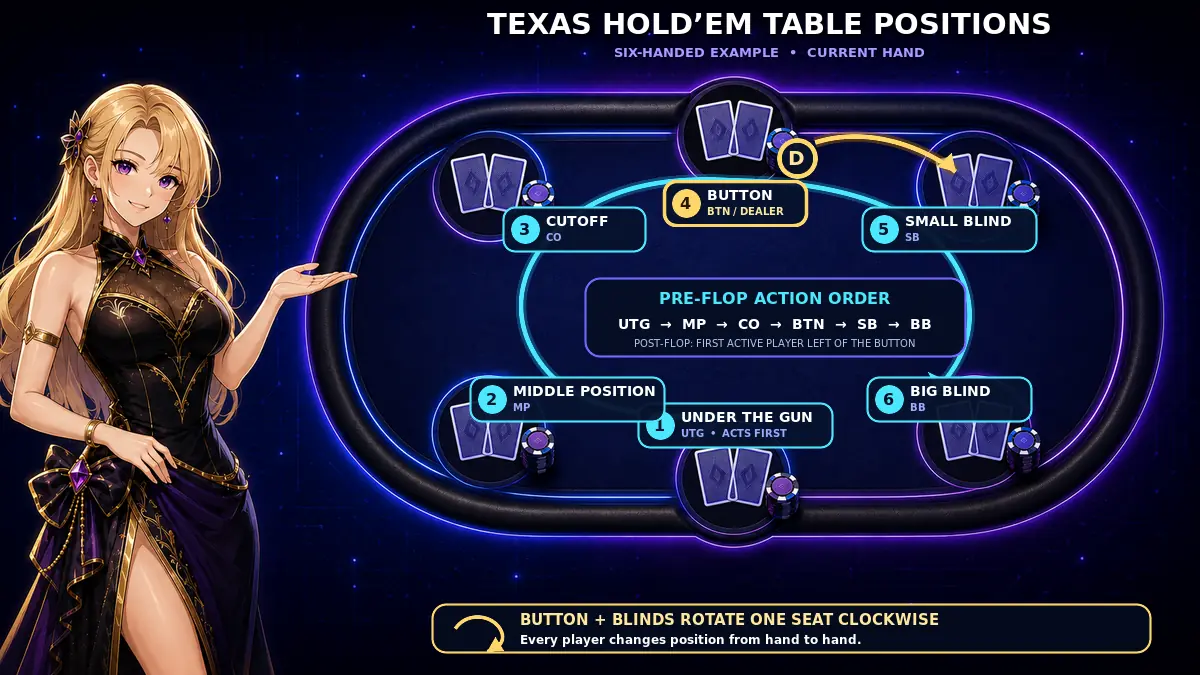
Future image: A six-player Hold’em table labeled UTG, middle position, cutoff, button, small blind and big blind, with arrows showing button rotation and action order.
Recommended: 1200 × 675 px, WebP, under 100 KB.
5. How a Texas Hold’em Hand Works Step by Step
1. Blinds and antes are posted
The required forced bets enter the pot before cards are dealt. Tournament antes may also apply.
2. Two hole cards are dealt
Each active player receives two private cards. Only the owner can see them during the hand. The first betting round is called pre-flop.
3. Pre-flop betting
Action normally begins with the first active player left of the big blind. That player can Fold, Call the big blind or Raise, subject to the table’s betting structure. Action continues until all remaining players have matched the highest wager, folded or moved all-in.
4. The flop
If at least two players remain, three community cards appear face up. A new betting round begins with the first active player left of the button. If no one has bet, players can Check.
5. The turn
A fourth community card appears, followed by another betting round.
6. The river
The fifth and final community card appears, followed by the final betting round.
7. Showdown
If two or more players remain after river betting, eligible hands are compared. The strongest five-card hand wins the pot, or the pot is divided when the best hands are exactly equal.
A hand can end before the flop, turn, river or showdown if every opponent folds. The last remaining player wins without needing to reveal the hole cards unless a specific house rule requires otherwise.

Future image: A left-to-right timeline showing blinds and hole cards, pre-flop betting, three-card flop, one-card turn, one-card river and showdown.
Recommended: 1200 × 675 px, WebP, under 100 KB.
6. Check, Bet, Call, Raise, Fold and All-in
| Action | What it means | When it is available |
|---|---|---|
| Check | Continue without adding chips. | Only when no unmatched bet is facing the player. |
| Bet | Make the first voluntary wager of the current betting round. | When no previous bet has been made in that round. |
| Call | Match the current highest wager to remain eligible. | When facing a bet or raise. |
| Raise | Increase the current wager. | When the betting structure and remaining stack permit a legal raise. |
| Fold | Give up the hand and any claim to the current pot. | When facing action or when the interface permits a voluntary fold. |
| All-in | Commit every remaining chip in the player’s stack. | Subject to table stakes and the legal-raise rules. |
A Check is not the same as a Fold. Checking keeps the hand active without adding chips. Folding ends participation in the hand.
A Call is not automatically a small decision. Calling a large all-in can risk the entire effective stack. The confirmation display should show the amount required.
Minimum raises
In No-Limit Hold’em, a full raise must generally be at least as large as the previous full bet or raise increment. An all-in for less than a full raise can increase the amount to call without necessarily reopening raising rights for players who already acted. Exact house and tournament rules control edge cases.
7. Poker Hand Rankings from Highest to Lowest
Traditional high-hand rankings are used in Texas Hold’em. Suits are equal for determining the winning hand.
| Rank | Hand | Definition | Example |
|---|---|---|---|
| 1 | Royal flush | Ace-high straight flush: A-K-Q-J-10 in one suit | A♠ K♠ Q♠ J♠ 10♠ |
| 2 | Straight flush | Five consecutive cards in one suit | 9♥ 8♥ 7♥ 6♥ 5♥ |
| 3 | Four of a kind | Four cards of the same rank plus one kicker | Q♣ Q♦ Q♥ Q♠ 7♣ |
| 4 | Full house | Three cards of one rank plus two of another | 10♣ 10♦ 10♠ 4♥ 4♠ |
| 5 | Flush | Five cards of one suit that are not a straight flush | A♦ J♦ 8♦ 5♦ 2♦ |
| 6 | Straight | Five consecutive ranks in mixed suits | 8♣ 7♦ 6♠ 5♥ 4♣ |
| 7 | Three of a kind | Three cards of one rank plus two kickers | 6♣ 6♦ 6♠ K♥ 9♣ |
| 8 | Two pair | Two cards of one rank, two of another and one kicker | A♣ A♦ 7♠ 7♥ K♣ |
| 9 | One pair | Two cards of one rank plus three kickers | J♣ J♥ A♦ 8♠ 4♣ |
| 10 | High card | No pair, straight, flush or stronger category | A♣ J♦ 8♠ 5♥ 3♣ |
Ace can be high in A-K-Q-J-10 or low in A-2-3-4-5. It cannot wrap around: Q-K-A-2-3 is not a straight.

Future image: A clear ten-row ranking graphic with one five-card example for every Texas Hold’em hand category from royal flush to high card.
Recommended: 1200 × 675 px, WebP, under 100 KB.
8. The Best-Five-Card Rule in Texas Hold’em
At showdown, each player uses the strongest five-card combination available from seven cards: two private cards and five community cards. The software does not score all seven as one hand.
Using both hole cards
Hole cards A♣ K♣ with a board of Q♣ J♣ 10♣ 4♦ 2♥ make a royal flush using both hole cards and three board cards.
Using one hole card
Hole cards A♠ 4♦ with a board of A♥ K♣ K♦ 9♠ 3♣ make two pair, Aces and Kings, with a 9 kicker. Only the Ace from the player’s hand is used.
Playing the board
If the community cards are A♠ K♠ Q♠ J♠ 10♠, every remaining player has the same royal flush unless the variant uses a different rule. Hole cards cannot improve the board, so the eligible pot is split.
A common beginner error is assuming both hole cards must be used. That rule applies to Omaha, not Texas Hold’em.
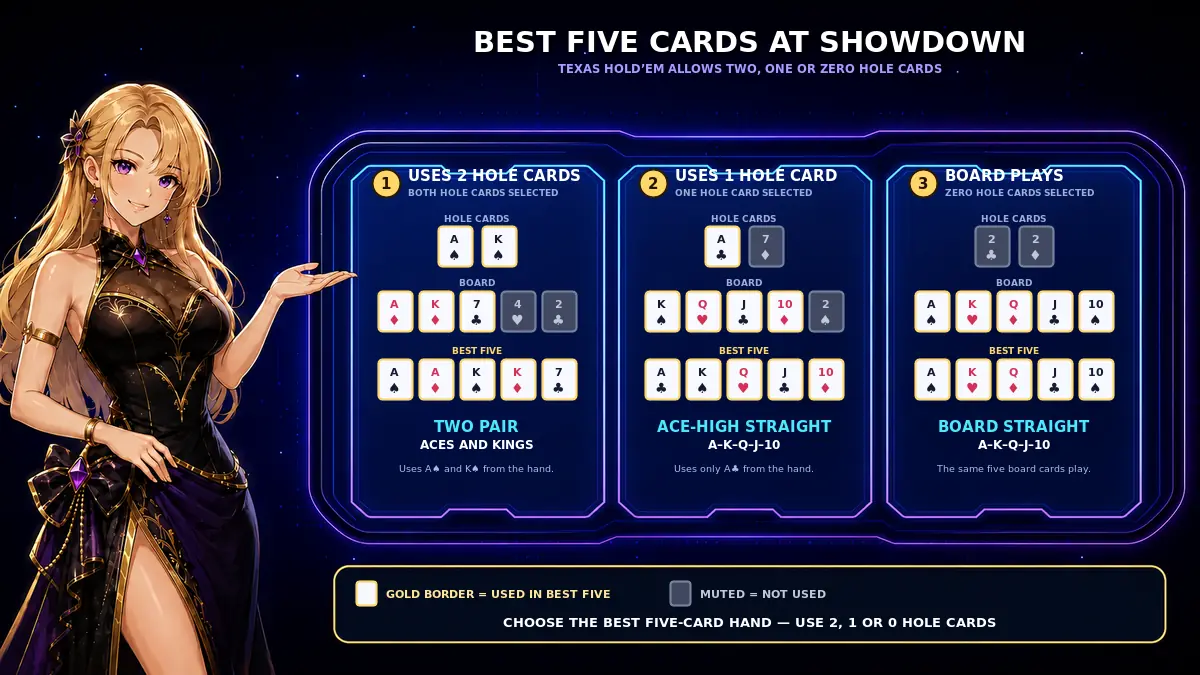
Future image: Three side-by-side examples showing a Hold’em hand using two hole cards, one hole card and no hole cards because the board plays.
Recommended: 1200 × 675 px, WebP, under 100 KB.
9. Poker Kickers, Tie-Breakers and Split Pots
When players share the same hand category, the five-card composition determines the winner.
- Straight or straight flush: compare the highest card in the sequence.
- Four of a kind: compare the four-card rank, then the kicker if the quads are on the board.
- Full house: compare the three-of-a-kind rank first, then the pair.
- Flush or high card: compare the highest card, then the next highest until a difference appears.
- Three of a kind: compare the trip rank, then the first and second kickers.
- Two pair: compare the higher pair, lower pair and then kicker.
- One pair: compare the pair, then each kicker in descending order.
Worked two-pair example
The board is A♠ K♦ 7♣ 7♥ 2♠. Player A holds A♥ Q♥ and makes Aces and Sevens with a King kicker. Player B holds K♣ Q♣ and makes Kings and Sevens with an Ace kicker. Player A wins because the higher pair—Aces—beats Kings. The kicker is considered only after both pair ranks.
Suits do not break a tie in standard Hold’em. If the best five cards are exactly equal, the eligible pot is divided. An indivisible odd chip is allocated according to the platform or tournament house rules.
10. No-Limit, Pot-Limit and Fixed-Limit Poker
| Betting structure | Maximum wager | Common use | Important beginner check |
|---|---|---|---|
| No-Limit | Up to the player’s full table stack | Texas Hold’em cash games and tournaments | A single decision can involve the entire effective stack. |
| Pot-Limit | Up to a calculated amount based on the current pot and call | Pot-Limit Omaha and some Hold’em games | The displayed pot-sized maximum can be larger than the pot shown before calling. |
| Fixed-Limit | Preset bet and raise units | Limit Hold’em and mixed games | Later streets may use a larger fixed unit and raises may be capped. |
“No-Limit” does not mean there are no rules. Minimum bets, minimum raises, table stakes and action-reopening procedures still apply. The maximum is limited by the chips already in the player’s table stack, not by funds elsewhere in an account.
11. Online Poker Cash Games vs Tournaments
| Feature | Cash game | Tournament |
|---|---|---|
| Chip meaning | Chips normally represent the monetary stake at the table. | Chips determine tournament survival and rank but do not directly equal cash value. |
| Blinds | Normally remain fixed for the selected table. | Increase according to scheduled blind levels. |
| Entry | Join with an amount inside the permitted buy-in range. | Pay a listed buy-in and fee for a starting stack. |
| Leaving | Usually leave and cash out the table stack subject to house rules. | Cannot cash out tournament chips; play continues until elimination or completion. |
| Losing the stack | May rebuy or top up within table limits. | Usually eliminated unless re-entry, rebuy or add-on rules apply. |
| Platform charge | Rake can be deducted from qualifying pots. | A disclosed fee is normally included with the buy-in. |
| Opponent changes | Players may join or leave the table. | Tables can balance or break as participants are eliminated. |
Common tournaments include scheduled multi-table tournaments, Sit & Go events that begin after a set number of entries, satellites awarding entry to another event, bounty tournaments and turbo formats with shorter blind levels. Read the prize structure, late-registration window, re-entry conditions and payout schedule before entering.

Future image: A two-column comparison showing fixed cash-game blinds and cash-value chips versus rising tournament blinds, a starting stack, entry fee and prize positions.
Recommended: 1200 × 675 px, WebP, under 100 KB.
12. How All-ins and Side Pots Work
A player may go all-in for less than the amount another player can wager. Table-stakes rules mean a participant can only win the portion of each opponent’s chips that the participant matched. Extra matched wagers among deeper stacks form one or more side pots.
Simple three-player example
Player A is all-in for 100 chips, Player B for 300 and Player C covers both with 500:
- The main pot contains 300 chips: 100 from each player. A, B and C can win it.
- The side pot contains 400 chips: another 200 each from B and C. Only B and C can win it.
- Player C’s unmatched final 200 is returned because no opponent matched it.
The main and side pots are awarded separately, so different players can win them with different hands. The online software calculates eligibility automatically, but the pot display should still be reviewed.
An all-in for less than a complete minimum raise may not reopen raising for players who already acted. This is one reason tournament and house rules matter in addition to the basic sequence of Hold’em.
13. Why Position Matters in Online Poker
Position describes when a player acts relative to opponents. Acting later provides more information because earlier players have already checked, bet, called or raised.
The button is usually the strongest post-flop position because it acts last after the flop. The blinds act late before the flop but early after the flop, which makes their positional situation more difficult.
Position affects starting-hand selection and pot control:
- Early position must act before many opponents and generally needs a more selective starting range.
- Late position can observe more decisions before acting.
- The same two hole cards can be playable from the button and unsuitable from UTG.
- A large stack does not remove positional disadvantage.
Position rotates with the button, so no seat remains the button indefinitely. Online labels such as UTG, HJ, CO, BTN, SB and BB help identify the current order.
14. Beginner Poker Decision Principles
Poker strategy changes with table size, position, stack depth, betting structure, opponent action and fee level. The following principles are educational starting points, not a guaranteed profit system.
Start with selective hand entry
Entering every pot creates repeated decisions with weak holdings. Begin with a selective range and widen it in later positions only when the situation supports doing so.
Consider the action before you
An unopened pot, one raise and a raise followed by a re-raise are different situations. A hand strong enough to open may not be strong enough to call a large re-raise.
Separate calling from continuing
A Call preserves the hand for the current action; it does not commit the player to later streets. Reassess when the board, bet size or number of opponents changes.
Use position
Acting last gives more information and can make it easier to control the pot. Avoid treating the same cards identically from every seat.
Know the effective stack
The effective stack is the smaller relevant stack between players in a confrontation. It caps how much those players can win from one another and changes the significance of a bet or all-in.
Value betting and bluffing are different
A value bet expects to be called by enough weaker hands. A bluff expects stronger hands to fold. Betting without identifying which purpose applies can lead to inconsistent sizing and avoidable risk.
Folding is a normal action
Money already placed in the pot is a sunk cost for the current decision. Calling only because “too much has already been invested” can add a new loss when the available information supports folding.
No chart can remove uncertainty or account perfectly for every opponent. Use strategy tools only when permitted by the platform, and never use prohibited real-time assistance.
15. Pot Odds, Outs and Drawing Hands
Pot odds compare the cost of a Call with the total pot that would exist after calling. They help evaluate whether a draw has sufficient estimated winning probability, but the estimate must consider whether the counted outs are actually clean.
Pot-odds example
The pot is ₱80 and an opponent bets ₱20, making the displayed pot ₱100. Calling costs ₱20 and would create a ₱120 pot. The break-even share is:
Call amount ÷ final pot after calling = ₱20 ÷ ₱120 = 16.7%
This does not mean the hand has 16.7% equity. It means the estimated chance of winning must exceed the break-even share after accounting for future action, rake and the possibility that an apparent out completes a stronger opponent hand.
What is an out?
An out is an unseen card believed to improve the hand to a likely winner. A four-card flush after the flop can have nine remaining cards of that suit, but those cards are not always nine clean winning outs. A paired board, higher possible flush or full-house redraw can change the analysis.
The common “rule of 2 and 4” gives a quick approximation: multiply outs by about 2 for one card to come or about 4 for two cards to come. It is an estimate, not an exact probability, and it should not replace a full calculation for large decisions.
Implied odds, reverse implied odds and opponent ranges add further uncertainty. Beginners should avoid using a simple out count as proof that a Call is automatically correct.
16. Online Poker Rake and Tournament Fees
A poker room normally earns revenue through fees rather than by holding the opposing hand.
Cash-game rake
Cash-game rake is commonly a percentage of a qualifying pot up to a cap. The percentage and cap can depend on stakes, table size and the number of players dealt into the hand. Some rooms use a “no flop, no drop” rule, while others have different collection procedures.
Tournament fees
A tournament entry may be displayed as two amounts, such as a 900-chip-equivalent buy-in plus a 100 fee. The first portion contributes to the prize pool and the fee goes to the operator. Bounties, re-entries and add-ons can have their own allocation.
Why fees matter
Two tables with the same blinds can have different effective costs because of rake percentage, cap and collection rules. A low-stakes game can charge a larger share of small pots than a capped higher-stakes game. Tournament value also depends on the fee as a percentage of the total entry.
Review the current rake schedule, tournament lobby and promotional terms directly. Do not assume that an advertised reward offsets the full fee or applies to every game type.
17. How to Read an Online Poker Table
Most online poker interfaces include:
- Hole-card area: displays the player’s private cards.
- Community-card board: displays the flop, turn and river.
- Dealer button and blind markers: identify position and forced wagers.
- Player stacks: show chips currently available at the table.
- Pot display: shows the main pot and, when relevant, side pots.
- Action buttons: Check, Bet, Call, Raise, Fold and All-in appear when legal.
- Bet slider and preset sizes: control the proposed wager.
- Action timer or time bank: limits decision time.
- Hand history: records completed deals and settled pots.
- Notes or player labels: may be permitted for personal observations.
- Sit-out and leave controls: pause or exit according to cash-game or tournament rules.
Before confirming a bet, verify whether the interface shows the amount being added or the new total raise amount. Platforms can label the control differently.
Disconnections and automatic actions
If the connection drops, the software may use the time bank, Check when no wager is faced, or Fold when a Call is required. Cash-game and tournament sit-out behavior can differ. Read the disconnection policy before entering a timed event.
The guide to online casino game software and result processing explains RNG and server-side concepts. When the current route is verified, the online poker game section can be used to compare available formats without mixing a game lobby into this rules article.
18. Online Poker Integrity and Account Safety
Because online poker involves competing against other participants, fair-play rules cover more than card generation.
- One player per account: do not share an account or allow another person to make decisions.
- No collusion: participants must not share hole cards or coordinate play against others.
- No multi-accounting: entering the same game through multiple accounts can create an unfair advantage and is commonly prohibited.
- No prohibited automation: bots and automated decision tools can violate platform rules.
- Check real-time-assistance rules: a resource allowed for study away from the table may be prohibited during live play.
- Protect login details: use a strong unique password and do not share one-time codes.
- Review device and session history: report unknown logins through the platform’s official support channel.
- Use the verified domain: avoid copied poker clients, fake support accounts and unofficial download links.
Responsible platforms can use shuffle testing, hand histories, device data and behavioral monitoring to investigate suspicious activity. These controls do not remove all financial risk or guarantee that every opponent is less skilled.
19. Common Online Poker Variants
| Variant | Private cards | Community cards | Critical rule difference |
|---|---|---|---|
| Texas Hold’em | 2 | Up to 5 | Use any combination to make the best five-card hand. |
| Omaha | Usually 4 | Up to 5 | Use exactly two hole cards and exactly three board cards. |
| Omaha Hi-Lo | Usually 4 | Up to 5 | Qualifying high and low hands can divide the pot; exact low rules apply. |
| Short Deck Hold’em | 2 | Up to 5 | Uses a reduced deck and can change straight and flush rankings. |
| Seven Card Stud | Seven individual cards in mixed face-up and face-down stages | None | Uses antes, a bring-in and visible player cards instead of a shared board. |
| Five Card Draw | 5 | None | Players replace selected cards during a draw round. |
| House-banked Hold’em | Often 2 | Often 5 | Compete against a dealer and paytable, not a field of poker-room opponents. |
| Video poker | Usually 5 virtual cards | None | Hold and draw against a fixed paytable rather than betting against opponents. |
Do not assume traditional Hold’em hand rankings apply unchanged to Short Deck or lowball games. Always open the variant rules before sitting at the table.
20. Learning Poker in Free-Play or Practice Mode
Free-play tables, tutorials or play-money games can help beginners learn the software and hand sequence without placing a real-money wager.
Practice should focus on:
- recognizing the button, blinds and current position;
- following pre-flop, flop, turn and river action;
- identifying the best five-card hand;
- distinguishing Check, Call and Fold;
- using the bet slider without accidental all-ins;
- reading stack sizes in big blinds;
- understanding main pots and side pots; and
- reviewing completed hands in the hand-history panel.
Play-money results do not predict real-money performance. Opponent behavior can also differ when chips have no cash value. Practice is best used to learn rules and controls, not to estimate future profit.
21. Online Poker Beginner Checklist
- Confirm the poker format. Identify poker room, house-banked poker or video poker.
- Confirm the variant. Do not use Hold’em rules at an Omaha or Short Deck table.
- Check cash game or tournament. Understand whether chips represent table value or tournament position.
- Check the betting structure. Identify No-Limit, Pot-Limit or Fixed-Limit.
- Check blinds and antes. Review their current size and, in tournaments, when they increase.
- Check the buy-in and effective stack. A low blind does not prevent a large stack from being at risk.
- Read rake or fees. Review the percentage, cap, entry allocation and re-entry costs.
- Review table size and speed. Heads-up, six-max, full-ring, turbo and fast-fold games create different decision frequencies.
- Understand time-bank rules. Know what happens if the timer or connection expires.
- Set money and time limits. Do not increase stakes to recover losses.
- Follow fair-play rules. Do not use prohibited assistance, shared accounts or collusive communication.
- Verify the operator and exact domain. A familiar poker brand or client design does not prove authorization.
22. Common Online Poker Mistakes and Myths
“I must use both hole cards in Texas Hold’em”
False. Hold’em can use two, one or zero hole cards. Omaha normally requires exactly two.
“Poker is always played against the casino”
False. Poker-room games are played against other participants. House-banked poker and video poker use different models.
“The strongest-looking seven cards determine the winner”
Only the best five-card combination counts at showdown.
“A flush beats a full house in Hold’em”
In traditional Hold’em, a full house beats a flush. Some Short Deck rules reverse that order, which is why the variant must be checked.
“Suits break ties”
Standard Hold’em suits are equal for hand ranking. Exactly equal best five-card hands split the eligible pot.
“Checking means I folded”
Checking keeps the hand active when no unmatched bet is faced. Folding gives up the hand.
“All-in means I can win every chip on the table”
A player can only win matched amounts from opponents. Extra wagers create side pots or are returned.
“Tournament chips can be cashed out whenever I leave”
Tournament chips normally have no direct cash value. Prizes depend on finishing position and the tournament payout structure.
“A strategy chart guarantees profit”
Poker strategy manages decisions under uncertainty. Opponents, cards, fees and variance prevent any guarantee.
“I should call because I already invested a lot”
Earlier chips are already in the pot. The current Call should be evaluated using current information, cost, range and expected outcome.
“A losing streak means I am due to win”
Past losses do not force the next hand to compensate. Increasing stakes to recover losses adds financial risk.
23. Online Poker Checks for Players in the Philippines
PAGCOR’s Electronic Gaming Licensing Department lists Online Poker Games among the electronic-gaming offerings it regulates. That does not mean every poker website, application or copied license badge is authorized.
Use the PAGCOR Guarantee website for checking legitimate online gaming platforms and verify the exact domain before downloading software, supplying identity documents or making a payment.
The PAGCOR Electronic Gaming Licensing Department information page describes its role and specifically includes Online Poker Games. The PAGCOR Responsible Gaming information page states that gambling is for people aged 21 and above and provides limit-setting, exclusion and support information.
Player-versus-player skill does not remove financial risk. Poker should not be treated as guaranteed income or a way to repay debt. Set limits for buy-ins, re-entries and total time, and stop rather than moving to higher stakes after a loss.
24. Frequently Asked Questions About Online Poker
How do you play poker online?
In Texas Hold’em, receive two private cards, use up to five community cards and make betting decisions through pre-flop, flop, turn and river rounds. Win by holding the strongest five-card hand at showdown or by making every opponent fold.
What is the objective of Texas Hold’em?
Win the pot by showing the strongest eligible five-card poker hand or by remaining as the only player after all opponents fold.
How many cards do you receive in Texas Hold’em?
Each player receives two private hole cards. Up to five community cards are dealt as the flop, turn and river.
Do you have to use both hole cards in Texas Hold’em?
No. A Hold’em hand may use both, one or none of the hole cards to form the best possible five-card hand. Omaha normally requires exactly two.
What are the poker hand rankings?
From highest to lowest: royal flush, straight flush, four of a kind, full house, flush, straight, three of a kind, two pair, one pair and high card.
What are the flop, turn and river?
The flop is the first three community cards, the turn is the fourth and the river is the fifth and final community card.
What do Check, Call and Fold mean?
Check continues without adding chips when no bet is faced. Call matches the current wager. Fold gives up the hand and any claim to the pot.
What are the small blind and big blind?
They are forced wagers normally posted by the two players left of the dealer button. Their positions rotate after each hand.
What does all-in mean in poker?
All-in commits every chip remaining in the player’s table stack. The player can only win matched amounts, while extra action among deeper stacks creates side pots.
What happens when two poker hands tie?
If the best five-card hands are exactly equal, the eligible pot is split. Suits do not break a tie in standard Texas Hold’em.
What is the difference between cash games and tournaments?
Cash-game chips normally represent table value and blinds usually remain fixed. Tournament chips determine survival and rank, blinds increase and prizes depend on finishing position.
What is poker rake?
Rake is a platform fee commonly deducted from qualifying cash-game pots, often as a percentage up to a cap. Tournaments normally charge a disclosed entry fee instead.
What is No-Limit Texas Hold’em?
It is a Hold’em betting structure in which a player may wager up to the full table stack, subject to minimum-bet, minimum-raise and table-stakes rules.
Why does position matter in poker?
Players acting later see earlier decisions before choosing their own action. The button normally acts last after the flop and therefore has more information.
What is the difference between poker-room poker and casino poker?
Poker-room games are played against other participants and use rake or tournament fees. House-banked casino poker is played against a dealer hand or fixed paytable.
What is the difference between Texas Hold’em and Omaha?
Hold’em gives each player two hole cards and allows any combination for the best five-card hand. Omaha normally gives four hole cards and requires exactly two hole cards plus exactly three board cards.
Can a poker strategy guarantee a profit?
No. Decisions can influence long-run results, but cards, opponents, fees and variance prevent any guarantee for a hand or session.
Is online poker legal in the Philippines?
Authorization depends on the operator and exact domain. PAGCOR lists Online Poker Games among regulated electronic-gaming offerings, but players should verify the specific platform through official PAGCOR resources.
The Bottom Line
To play poker online, first identify the format. In a Texas Hold’em poker room, you play against other participants using two private cards and up to five community cards. The pot can be won at showdown with the best five-card hand or earlier when every opponent folds.
Learn positions, blinds, action order, betting terms and hand rankings before focusing on strategy. Check whether the game is cash or tournament, No-Limit or another structure, and review rake, fees, stack size, time-bank rules and platform integrity policies. Skill affects decisions, but it cannot guarantee profit or eliminate financial risk.
Reference sources
- PokerStars — Texas Hold’em Rules and Hand Structure https://www.pokerstars.com/poker/games/texas-holdem/
- PokerStars — Traditional Poker Hand Rankings https://www.pokerstars.com/poker/games/rules/hand-rankings/
- Poker Tournament Directors Association — Official Tournament Rules and Procedures https://www.pokertda.com/view-poker-tda-rules/
- WSOP Online — Poker House Rules, Cash-Game Rake and Tournament Fees https://www.wsoponline.com/nj/legal/house-rules
- Gaming Laboratories International — iGaming Technical Standards and Testing https://gaminglabs.com/services/igaming/igaming-technical-standards/
- PAGCOR Guarantee — Online Gaming Platform Verification https://www.pagcorguarantee.ph/
- PAGCOR — Electronic Gaming Licensing Department and Online Poker Games https://www.pagcor.ph/regulatory/cegs.php
- PAGCOR — Responsible Gaming Information https://www.pagcor.ph/regulatory/responsible-gaming.php