
How Online Slot Games Work: Reels, Paylines and Features Explained
Understand the parts of an online slot screen and how games evaluate results through reels, rows, paylines, ways-to-win, clusters, cascades, wilds, scatters, multipliers, free spins and paytables.

How online slot games work in brief
An online slot round begins when the player confirms a stake and presses Spin. The game engine produces a result, then the screen displays that result as symbols on reels or a grid. The paytable checks whether those symbols meet the game’s winning rules—such as a payline, adjacent-reel way, matching cluster or pay-anywhere count.
Wilds can substitute under stated rules; scatters can award prizes or trigger features; cascades can replace symbols after a qualifying win; and multipliers can modify a specified payout. None of these terms has one universal implementation. The paytable for the exact game version controls how every combination and feature is settled.
What Is an Online Slot Game?
An online slot is a software game that presents results through reels, rows and symbols. A player selects a stake and starts a round. The result is then compared with the title’s paytable to determine whether it qualifies for a payout or feature.
Modern slots can look very different from the traditional three-reel machine. A title may use:
- three, five, six or more reels;
- a fixed or changing number of rows;
- fixed paylines or selectable paylines;
- ways-to-win across adjacent reels;
- matching clusters or pay-anywhere counts;
- cascading, tumbling or avalanche sequences;
- wilds, scatters and multiplier symbols; and
- free spins, hold-and-win rounds, wheels or other bonus features.
These mechanics determine how a result is displayed and evaluated. They do not replace the mathematics built into the game. A slot with more paylines, a larger grid or a more animated feature is not automatically more likely to return a profit.
Slots are one of the major types of online casino games. To explore the current catalogue, browse CasinoGameOnline.ph’s online slot games directory.
Anatomy of an Online Slot Screen
Most slot interfaces contain the following elements, although labels and positions vary by provider:
| Screen element | What it shows or controls | What to check |
|---|---|---|
| Reel grid | The symbols displayed for the current result | Number of reels, rows and active positions |
| Spin button | Confirms the stake and starts a paid or demo round | Total cost shown before pressing it |
| Bet control | Changes denomination, level, lines or total stake | Whether the value is per line or total per spin |
| Balance | Available real or virtual credits | Whether the display uses pesos, credits or another unit |
| Win display | Amount credited for the completed result or sequence | Whether it shows the current cascade or total round win |
| Paytable or information | Rules, symbol values, features and mathematical information | The exact game version, RTP configuration and settlement rules |
| Sound and speed controls | Adjust presentation and animation speed where available | Faster animation can increase playing pace |
| Automatic play control | Repeats rounds automatically where permitted | Availability, stop conditions and total exposure; some jurisdictions prohibit it |
| Feature purchase or special bet | Changes the cost or access path for a bonus where offered | Total price, changed rules and whether it is permitted locally |
Do not press Spin until the interface clearly shows the intended total stake. A label such as “1.00” can represent one peso, one credit, a per-line amount or another denomination depending on the game.
How One Online Slot Round Works
- The player selects a stake: The game displays the total amount required to start one round. In a payline game, the interface may calculate that total from line bet, number of active lines and denomination. In another title, the selected value may already be the complete cost per spin.
- The player presses Spin: Pressing Spin commits the displayed stake. The software requests or receives the values needed to determine the outcome. Our How Online Casino Games Work guide explains the RNG, server and game-engine process in detail.
- The reels display the result: The reel animation presents the selected symbols and positions. The visual stopping order does not mean that the final reel is still deciding the outcome after the others stop.
- The paytable evaluates qualifying combinations: The game checks the displayed result against its active pay model: paylines, ways, clusters, pay-anywhere counts or another disclosed rule. More than one combination can qualify in the same result.
- Features are applied: Wild substitution, scatter awards, multipliers, cascades and bonus triggers are applied under the title’s rules. A cascade can create several evaluation steps inside the same initiated round.
- The round is settled: The interface credits the final amount after the base result and all connected feature steps finish. The next paid spin should not begin until another stake is confirmed, except where an automatic-play feature is lawfully available and deliberately enabled.
Reels, Rows and Slot Grids
A reel is a vertical column of symbols. A row is a horizontal line of visible positions. Together they form the game grid.
A 5×3 slot has five reels and three visible rows, producing 15 positions on screen. A 6×5 slot has six reels and five rows, producing 30 visible positions. The first number normally describes reels and the second describes rows, but confirm the game information if the notation is unclear.
The visible symbols are only the presentation layer. A digital reel can use a virtual symbol distribution that is not visible as one short physical strip. Two symbols that look equally common in the artwork do not have to occupy the same number of mathematical positions.
Some games alter the grid:
- Expanding rows: additional positions open under stated conditions.
- Changing reel heights: each reel can display a different number of symbols from one round to another.
- Split symbols: one visible position can represent multiple matching symbols for evaluation.
- Locked positions: symbols or multipliers can remain in place during a feature.
- Additional reels: a bonus mode can use a larger or separate grid.
A larger grid creates more visible positions but does not by itself establish better RTP, lower volatility or a greater probability of profit.
Low-Value, High-Value and Special Symbols
Slot artwork normally groups symbols by their purpose and paytable value.
Low-value symbols
Card ranks, simple shapes or basic themed objects commonly occupy the lower end of the paytable. They may appear more often than premium symbols, but the actual frequency is controlled by the game design.
High-value symbols
Characters, rare objects or premium icons commonly pay more for the same number of matching symbols. Higher displayed value does not mean that the symbol has the same probability as a lower-value symbol.
Special symbols
Wilds, scatters, multipliers, collectors, bombs, upgrade symbols, expanding symbols and feature icons can modify evaluation or trigger another game state. A symbol may have more than one role—for example, a scatter might also award a direct payout—but only if the paytable says so.
Do not infer a symbol’s function from appearance alone. A crown may be an ordinary premium symbol in one slot and a collector in another. Open the paytable before assuming that a bright or animated icon is a wild, scatter or bonus trigger.
How Online Slot Wins Are Evaluated
A displayed result becomes a win only when it satisfies the title’s stated evaluation rules. The principal systems are:
- Paylines: matching symbols land on one of the permitted line patterns.
- Ways-to-win: matching symbols land on consecutive reels, commonly beginning with the leftmost reel, regardless of their row.
- Cluster pays: a minimum number of matching symbols touch within the grid under the stated adjacency rule.
- Pay anywhere or scatter pays: a required number of matching symbols appears anywhere on the active grid.
- Count or collection mechanics: specified symbols accumulate or satisfy a feature-specific condition.
The game may combine systems. A slot can use pay-anywhere wins for regular symbols, scatter counting for free spins and a separate collector during the bonus. Never apply one game’s evaluation rule to another title with similar artwork.
| Evaluation system | What must match | Does row position matter? | Main paytable check |
|---|---|---|---|
| Payline | Symbols on a permitted route across the reels | Yes | Line pattern, direction and active-line rules |
| Ways-to-win | Symbols on consecutive reels | Usually no | Starting reel, required reel count and exclusions |
| Cluster pays | A connected group of matching symbols | Adjacency matters rather than a line | Minimum cluster size and whether diagonal contact counts |
| Pay anywhere | A required count of matching symbols anywhere | No | Minimum symbol count and grid area included |
How Slot Paylines Work
A payline is a defined route through reel positions. It can run straight across one row or bend between rows in a zigzag, V, W or another pattern. A slot can have one line, several fixed lines or a selectable number of lines.
A common payline win requires matching symbols on consecutive reels from left to right, beginning on the first reel. That rule is not universal. Some games pay both directions, use adjacent matches from either side or apply special rules to wilds and scatters.
Fixed versus selectable paylines
- Fixed paylines: every listed line is active on every paid spin. Changing the stake changes the amount associated with the complete game, not which lines exist.
- Selectable paylines: the player can activate fewer or more lines. Reducing lines lowers total coverage and can make some displayed combinations ineligible.
Why stake wording matters
Suppose a game has 20 selectable lines and shows a ₱1 line bet. If all lines are active, the total cost may be ₱20 per spin. Another game can display “₱20 total bet” for the same exposure. Confirm whether the paytable awards symbol values from the line bet, coin value, bet level or complete stake.
A large number of paylines does not automatically improve expected return. More active lines can create more routes for a qualifying combination, but they can also increase the total amount staked per spin.

How Ways-to-Win Systems Work
A ways-to-win slot commonly pays when matching symbols appear on consecutive reels from the leftmost reel, regardless of row. The game does not need a drawn payline because every qualifying symbol position on a reel can connect with every qualifying position on the next reel.
Worked ways example
Assume the same symbol appears:
- twice on reel 1;
- three times on reel 2; and
- once on reel 3.
The number of three-reel combinations is:
2 × 3 × 1 = 6 winning ways
If that symbol does not appear on reel 4, the chain normally ends at three reels. If it appears twice on reel 4, the same result can contain 2 × 3 × 1 × 2 = 12 four-reel ways, subject to the exact paytable.
What “243 ways” means
On a fixed 5×3 grid, there are three possible row positions on each of five reels. Multiplying 3 × 3 × 3 × 3 × 3 gives 243 possible five-reel position paths. The advertised number describes potential positional combinations; it does not mean that 243 wins occur on every spin.
Some games use changing reel heights, producing a different number of possible ways from one spin to the next. Others pay adjacent matches from both sides or use a separate all-ways rule. The game information controls the starting reel, minimum consecutive reels, direction and whether wilds participate.
Cluster Pays and Pay-Anywhere Systems
Cluster pays
A cluster-pays slot awards a result when enough matching symbols form a connected group. Games commonly count symbols touching horizontally or vertically; diagonal contact may or may not count. The paytable identifies the minimum group size and the value for larger clusters.
For example, a game might require five matching gems. A group of four does not qualify even if another matching gem sits diagonally nearby—unless the rules count diagonals. A large connected group can be paid as one cluster rather than several smaller clusters, depending on the evaluation method.
Pay anywhere or scatter pays
Pay-anywhere systems count a required number of matching symbols across the complete active grid without requiring them to touch. A game can award different values for eight, nine, ten, eleven or twelve matching symbols, for example.
Pay-anywhere regular-symbol wins should not be confused with a scatter symbol. Both can ignore paylines, but a named scatter can have a special payout or feature-triggering role.
Cluster and pay-anywhere games often use cascades, but the two concepts are separate. The evaluation rule determines whether the displayed symbols win; the cascade determines what happens after qualifying symbols are removed.
Cascading Reels and Tumbling Wins
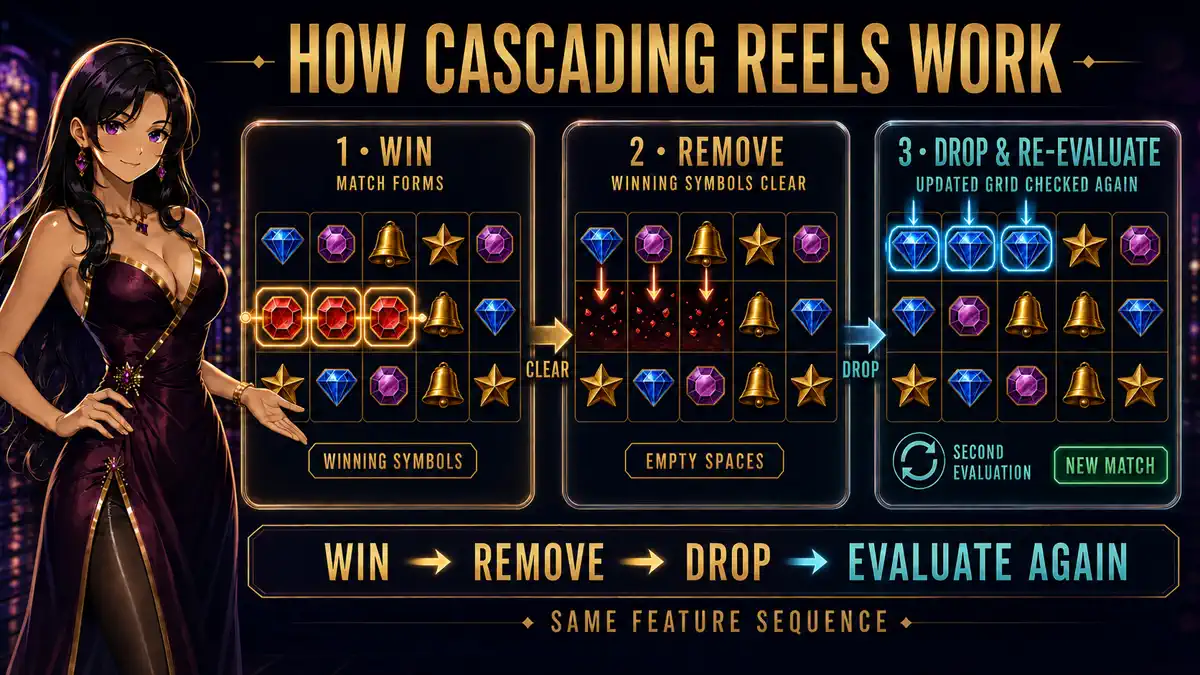
In a cascade, tumble or avalanche sequence, symbols involved in a qualifying win disappear or move away. New symbols fall or enter the empty positions, and the updated grid is evaluated again.
A common sequence is:
- The paid spin lands.
- The game identifies one or more qualifying wins.
- Winning symbols are removed.
- Remaining symbols drop into open spaces.
- New symbols fill the grid.
- The updated result is evaluated.
- The process repeats until no new qualifying win remains.
Several cascades can occur within one initiated spin without another base-game stake. That does not mean each cascade is a free spin; it is a continuation step governed by the cascade rules. Some titles reset multipliers after the sequence ends, while others increase a multiplier after each consecutive cascade or preserve it during free spins.
Read how the game handles simultaneous wins, overlapping clusters, multiplier symbols and maximum-win limits. Similar words such as tumble, cascade and avalanche do not guarantee identical implementation.
How Wild Symbols Work
A wild commonly substitutes for specified regular symbols to complete or improve a qualifying combination. It works like a flexible symbol, but its exclusions and additional abilities differ by game.
Common wild types include:
- Standard wild: substitutes for listed regular symbols.
- Expanding wild: grows to cover more positions or an entire reel.
- Sticky wild: remains in place for a stated number of respins or free spins.
- Walking wild: moves across the grid during connected steps.
- Multiplier wild: substitutes and applies a multiplier under specified conditions.
- Stacked wild: occupies several adjacent positions on one reel.
A wild often does not substitute for a scatter, bonus or jackpot symbol. Some wilds have their own payout; others only substitute. If two possible substitutions exist, the game normally evaluates the highest valid payout under its rules, but confirm the paytable.
How Scatter Symbols Work
A scatter is a special symbol commonly evaluated by count rather than by line position. Three or more can trigger free spins in one game, while another might require four. A scatter can appear anywhere, only on specified reels or only in the base game.
Possible scatter functions include:
- triggering free spins or another bonus;
- awarding a direct payout based on how many appear;
- retriggering additional free spins;
- choosing between feature modes; or
- contributing to a collector or progress meter.
A “near miss” with one fewer scatter than required is still a non-triggering result. The appearance of two scatters does not make the missing third scatter more likely on the next spin.
How Slot Multipliers Work
A multiplier increases a defined value by the displayed factor. The important question is not only “What is the multiplier?” but “What does it multiply, and when?”
A multiplier can apply to:
- one symbol payout;
- one payline or way;
- one cluster;
- the current cascade win;
- the total win from a tumble sequence;
- all wins during a free-spin round; or
- a collected value after several feature steps.
Added versus multiplied values
Suppose 2× and 3× multiplier symbols appear. One game may add them and apply 5× to the qualifying win. Another may multiply them to produce 6×. A third may apply each only to the symbol or reel on which it landed. The artwork cannot answer this; the paytable must.
Persistent and increasing multipliers
A cascade meter can increase from 1× to 2× to 3× after consecutive wins, then reset when the sequence ends. A free-spin feature can retain collected multipliers for all remaining spins. Another title can reset the value every spin. Do not transfer expectations between games.
A large advertised maximum multiplier is a possible feature value, not a prediction of what a normal session will receive.
Free Spins and Other Bonus Features
Free spins are additional slot rounds awarded under the game’s trigger rules without another standard base-spin stake being deducted for each awarded spin. They are not “risk-free” in the broader sense because they are normally reached through a paid result or, where offered, a separately priced feature purchase.
A free-spin feature may change:
- the number or value of wilds;
- the multiplier range;
- whether multipliers persist;
- the reel grid or symbol set;
- the cascade multiplier;
- the number of collector or upgrade symbols; and
- the conditions for awarding additional spins.
Other bonus formats include respins, hold-and-win grids, pick features, prize wheels, expanding boards and symbol collections. A bonus can still finish with no payout or with less than the stake that led to it. Triggering a feature does not guarantee profit.
Feature purchases and special bets
Some titles and jurisdictions allow a higher-cost purchase or special bet that changes access to a feature. Check the complete cost, changed RTP if disclosed, trigger method, maximum win and local availability. Paying directly for a feature does not make its result profitable or remove variance.
How to Read an Online Slot Paytable
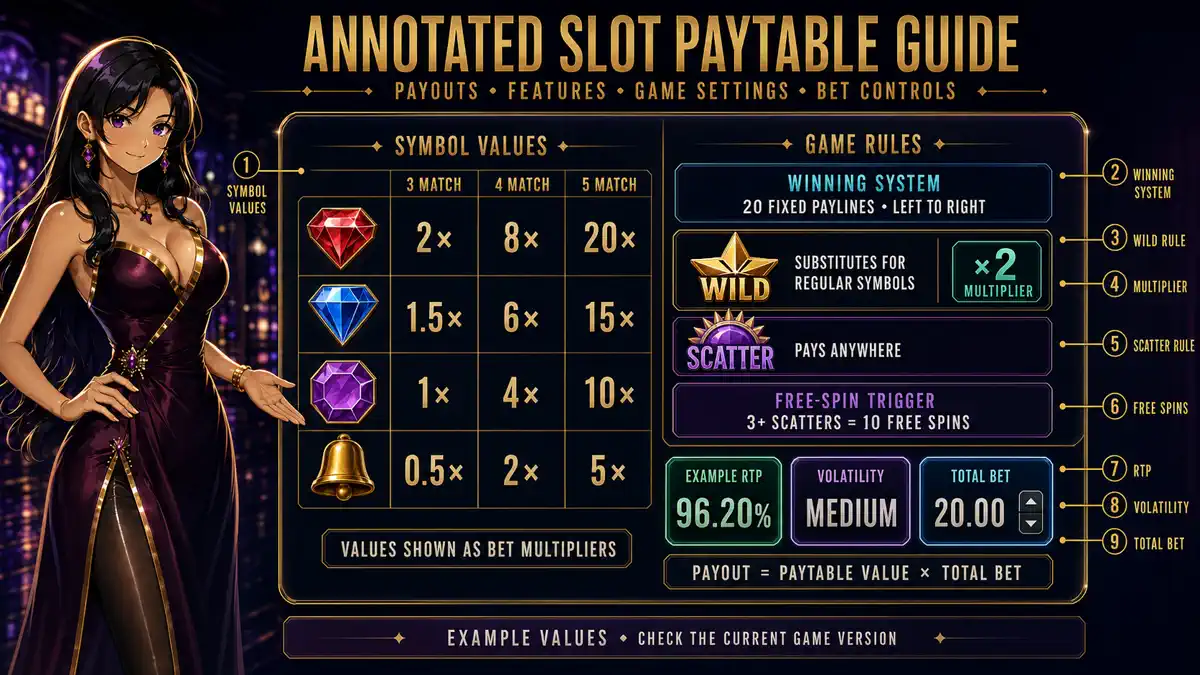
The paytable is the most important reference inside a slot. It should explain what counts as a win, how payouts are calculated and how each feature operates.
Before spinning, find:
- Game name, provider and version: similar titles or sequels can use different mechanics.
- Total stake: confirm the complete amount charged per spin.
- Win model: identify paylines, ways, clusters, pay-anywhere counts or another system.
- Direction: check whether matches start from the left, pay both ways or follow another rule.
- Symbol payouts: compare how many matching symbols are required and whether values use line bet or total bet.
- Wild rules: note substitution exclusions and extra abilities.
- Scatter rules: note the required count, eligible reels, direct payouts and feature triggers.
- Cascade rules: check which symbols disappear and when a sequence finishes.
- Multiplier rules: determine what is multiplied and whether multiple values add or multiply together.
- Bonus rules: confirm initial spins, retriggers, changed symbols and feature-specific multipliers.
- RTP and volatility: use the value for the exact configuration where disclosed.
- Maximum-win rule: note any payout cap or rule that ends a round after a limit is reached.
Paytables can change between configurations, platforms or jurisdictions. Do not use a screenshot from another website as the final authority for the version currently open.
Learn more: How to read a slot paytable
Bet Controls and Cost per Spin
The cost of a slot round can be displayed in several ways:
- Total bet: the complete amount charged for one spin.
- Coin value: the value assigned to one credit or coin unit.
- Bet level: a multiplier used with the coin value and game configuration.
- Line bet: the amount allocated to each active payline.
- Special-bet surcharge: an added amount for enhanced feature frequency or another stated rule where offered.
Do not assume that raising the stake improves the probability of the same base-game result. In many games it scales possible payouts in proportion to the amount wagered. A particular feature or jackpot can require a minimum stake, but that condition must be stated in the rules.
Faster spin settings shorten animations and can increase the number of paid rounds completed in a session. They do not improve the RTP per spin. More rounds can increase total turnover and exposure to the game’s house edge.
RTP, Volatility and Hit Frequency Are Different
Slot mechanics describe how a result is presented. Mathematical measures describe the long-run design and distribution of results.
- RTP: the theoretical percentage of total stakes returned across a very large sample under the stated game configuration.
- House edge: 100% minus RTP when both figures describe the same game and assumptions.
- Volatility or variance: how wins are distributed, including the relative balance between frequent smaller wins and less frequent larger wins.
- Hit frequency: how often a spin produces a result counted by the game as a win, which can include payouts smaller than the original stake.
- Feature frequency: how often a named bonus is expected to trigger, where disclosed.
A game can have a high hit frequency but still have a house edge because many “winning” results can return less than the amount staked. Two slots can publish the same RTP while using different volatility, feature frequency and maximum-win structures.
Read our Return to Player and House Edge Explained guide for theoretical return and sample size. Read our Casino Game Volatility and Variance Explained guide for payout distribution, bankroll swings and why short sessions can look very different.
How to Use Online Slot Demo Mode
Demo mode supplies virtual credits so a player can inspect controls and mechanics without staking real money. Demo winnings cannot be withdrawn. To learn more about practice mode vs paid mode, see What slot demo mode can teach you.
What to check in a demo
- Open the paytable before the first spin.
- Confirm the reels, rows and evaluation system.
- Identify wild, scatter and multiplier symbols.
- Check whether the displayed amount is total bet or another unit.
- Observe how the game highlights paylines, ways or clusters.
- Watch when a cascade begins and when the sequence resets.
- Check how a bonus trigger and retrigger are explained.
- Find the RTP, volatility and maximum-win information where available.
Demo mode cannot prove that a game is “hot,” estimate long-run RTP from a few spins or predict when a bonus will appear. A 20-spin or 100-spin sample is far too small for those conclusions.
In regulated contexts, play-for-free games may be required to represent the corresponding money game accurately. That does not mean that unrelated websites, providers or configurations are identical. Recheck the game name, provider, rules and RTP before moving between demo and real-money modes.
Explore free online slot demonstrations and game guides available through CasinoGameOnline.ph Free Games.
Slot Mechanic Examples from CasinoGameOnline.ph Reviews
Our individual reviews show how the same concepts appear in different interfaces. Always use the paytable inside the current game as the final authority.
Cascading and pay-anywhere examples
- Super Ace game guide and free demo
- Sweet Bonanza game guide and free demo
- Sweet Bonanza 1000 game guide and free demo
- Gates of Olympus game guide and free demo
- Gates of Olympus 1000 game guide and free demo
- Mahjong Ways game guide and free demo
Use these reviews to compare how cascading symbols, pay-anywhere or ways-based evaluation, multipliers and free-spin features are presented. A shared mechanic name does not mean the trigger counts or multiplier behavior are identical.
Compact reel and payline examples
- Fortune Gems game guide and free demo
- Fortune Gems 2 game guide and free demo
- Fortune Gems 3 game guide and free demo
- Seven Seven Seven game guide and free demo
- Wild Buffalo game guide and free demo
These pages are useful for comparing compact grids, fixed line patterns, symbol paytables and game-specific multiplier or feature controls.
Cluster and progression example
The Gem Party review illustrates how connected symbol groups, cascades and board progression can replace traditional paylines. Browse all reviews at our Game Reviews Index.
Common Online Slot Myths and Mistakes
A slot is due after a long losing sequence
Independent RNG outcomes do not carry a debt from earlier spins. A long run without a bonus does not force the next spin to trigger one.
Stopping the reels changes the result
A stop control commonly shortens the animation after the game has received or determined the result. It does not let the player select the final symbols unless the rules explicitly describe a skill feature.
A near miss means the bonus is getting closer
Landing one fewer scatter than required is a non-triggering result. It does not create progress unless the game visibly stores that symbol under a disclosed collection mechanic.
More paylines or ways always means better odds
More winning routes change how combinations can form, but game mathematics, symbol distribution, stake and payouts determine expected return. The advertised number of ways is not an RTP figure.
A larger bet makes the bonus arrive
A higher stake commonly scales both cost and possible payout. It does not automatically improve feature probability. Check the rules for any minimum-stake or special-bet condition.
Free spins guarantee a win
A free-spin feature can finish with a small payout or none. The name means no additional standard base-spin stake is deducted for each awarded spin; it does not guarantee profit.
Comparing only maximum win
Maximum win is a cap or rare possible outcome, not a typical result. Compare RTP, volatility, hit frequency, feature rules and total stake rather than choosing from maximum-win marketing alone.
Assuming every version has the same RTP
Some providers offer more than one approved RTP configuration. Check the information panel of the exact game version instead of copying a percentage from another website.
Beginner Online Slot Checklist
- Confirm the title, provider and version.
- Check the complete cost per spin.
- Identify reels, rows and active grid positions.
- Find whether the game uses paylines, ways, clusters or pay-anywhere rules.
- Read the wild, scatter and multiplier definitions.
- Check how free spins trigger and whether they can retrigger.
- Find the RTP, volatility and maximum-win rule where disclosed.
- Use demo mode to practise the interface when available.
- Do not use recent results to predict the next spin.
- Set time and spending limits before starting.
Our RNG and casino game-engine guide, RTP guide and volatility guide provide the technical and mathematical background for this checklist.
Checks for Online Slot Games in the Philippines
Online gaming involves legal, financial and personal-risk considerations. A slot opening in a browser does not by itself establish that the operator is authorized or that a person is eligible to use it.
- Age and eligibility: PAGCOR states that gaming is for people aged 21 and above and identifies additional restricted persons. Do not bypass age, identity or eligibility checks.
- Operator verification: use the PAGCOR Guarantee list of authorized online gaming websites rather than trusting a copied logo, advertisement or certificate screenshot.
- Game information: confirm the provider, exact title, rules, total stake, paytable and RTP configuration.
- Account security: use a unique password and never share an OTP, password or financial credential.
- Responsible play: set a fixed entertainment budget and time limit, never borrow to gamble and stop if play affects essential expenses or wellbeing.
PAGCOR’s Responsible Gaming information explains restricted-person and exclusion measures. Authorized-site lists and regulations can change, so verify current information directly with the regulator.
Ready to Play Online Slots for Real Money?
Discover top-rated, licensed Philippine online casinos with thousands of real-money slots, Megaways, cascading reels, and fast GCash & Maya payouts.
Frequently Asked Questions
How do online slot games work?
An online slot round begins when a player confirms a total stake and presses Spin. The game server generates a random outcome, then displays the result on a grid of reels and symbols. The paytable evaluates whether the result satisfies a winning condition—such as a payline, ways-to-win connection, cluster, or pay-anywhere count—and settles any qualifying payouts or features.
What are reels and rows in an online slot?
A reel is a vertical column of symbols, and a row is a horizontal line of visible positions across those columns. Together they form the game grid (such as 5×3 or 6×5). Digital reels display software-driven visual results rather than short physical strips.
What is the difference between paylines and ways-to-win?
Paylines require matching symbols to land on specific predetermined paths across the grid. Ways-to-win systems evaluate matching symbols appearing anywhere on consecutive reels, usually starting from the leftmost reel, regardless of row position.
What is a cluster-pays slot?
A cluster-pays slot replaces traditional paylines with group adjacency rules. Wins are awarded when a required minimum number of matching symbols touch horizontally or vertically anywhere on the grid.
Are cascading reels the same as free spins?
No. A cascade (or tumble) removes winning symbols from the current spin and drops new ones into empty spaces within the same initiated round. Free spins are separate bonus rounds awarded by scatters or feature triggers that grant additional full spins without deducting a base stake.
What is the difference between a wild and a scatter?
A wild symbol substitutes for regular symbols to complete or improve winning combinations. A scatter symbol is evaluated by total count anywhere on the grid, often paying direct prizes or triggering free spins and bonus features.
Do two slot multipliers add together or multiply each other?
It depends on the specific game rules. Some slots add multiplier values together (e.g., 2× plus 3× equals 5×), while others compound them (2× times 3× equals 6×). Always consult the game's official paytable.
Does a higher number of paylines mean a higher RTP?
No. Having more paylines or ways-to-win increases the number of potential winning routes per spin, but RTP (Return to Player) is governed by the underlying game mathematics, symbol frequencies, and paytable values.
Can I test online slots in demo mode?
Yes. Free demo mode provides virtual credits so players can test game interface controls, view paytables, and experience cascades or features without risking real money.
How should Filipino players verify an online slot website?
Filipino players should verify operator licensing against PAGCOR's official list of authorized online gaming platforms, confirm age eligibility (21+), review game paytables and provider testing information, and practice responsible bankroll management.
Sources and Further Reading
- UK Gambling Commission RTS 3 — game rules, descriptions, payouts and likelihood information
- UK Gambling Commission RTS 6 — play-for-free game representation
- UK Gambling Commission RTS 7 — random outcomes and paytable implementation
- Pragmatic Play — Sweet Bonanza 1000 pays-anywhere, tumble, scatter and multiplier mechanics
- Pragmatic Play — Gates of Olympus 1000 grid, tumbling wins, multipliers and free spins
- PAGCOR Responsible Gaming
- PAGCOR Guarantee authorized online gaming websites
Responsible gaming: Online slots are games of chance and no mechanic, strategy or betting pattern guarantees a profit. Set time and spending limits, never chase losses, never borrow to gamble and do not use money required for essential expenses. Participation is for eligible adults only and remains subject to applicable rules and restrictions.