
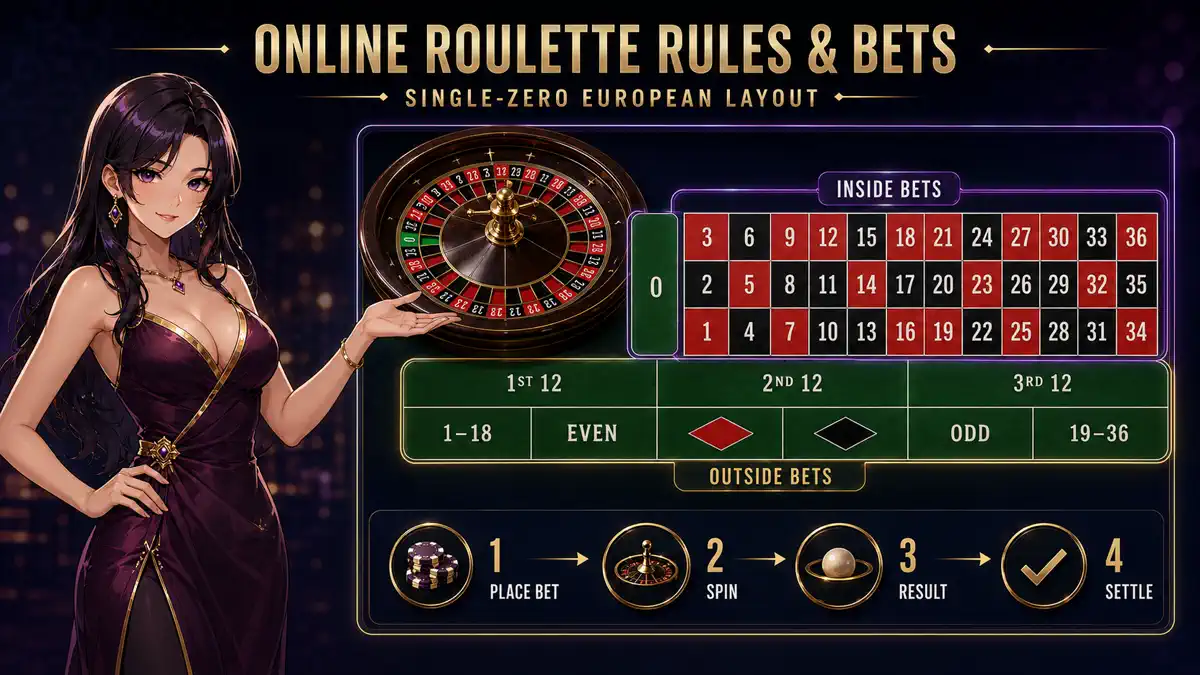
What Is Online Roulette?
Online Roulette is a digital version of the casino wheel game. Players do not compete to build a hand or make decisions after cards are dealt. Instead, they place wagers on a numbered betting layout before the winning pocket is selected.
The name comes from the French word for “little wheel.” Standard layouts use numbers 1 through 36, divided between red and black, plus at least one green zero pocket. European-style Roulette normally uses one zero. American-style Roulette normally adds a second green pocket marked double zero.
The objective is straightforward: place a bet that includes the number on which the ball lands—or the number generated by the approved software in an RNG game. You may back one exact number, several adjacent numbers or a larger group such as red, black, odd, even, a dozen or a column.
Roulette is one of the principal types of online casino games and belongs to the wheel-game section of the online casino table-games guide. Unlike Blackjack or Poker, standard Roulette does not give the player a decision after betting closes.
Learn more: Roulette payout ratios versus probability
Roulette Wheel and Betting-Table Layout
The wheel and the betting table display the same possible outcomes in different arrangements.
The Roulette wheel
A common European wheel has 37 pockets: numbers 1–36 and one zero. A common American wheel has 38 pockets: numbers 1–36, zero and double zero. The number order around the physical wheel is not numerical and differs between European and American configurations.
On a live table, a dealer—also called a croupier—spins the wheel and sends the ball in the opposite direction around the track. The ball eventually drops into a numbered pocket. In RNG Roulette, software generates the result and the interface animates a wheel to display it.
The betting layout
The central grid contains numbers 1–36. Zero appears at one end, with double zero added on an American layout. The outer areas contain group wagers such as red or black, odd or even, 1–18 or 19–36, dozens and columns.
The point where a chip is placed determines its coverage. A chip in the centre of one numbered square is a straight-up bet. A chip on the line between two numbers is a split. A chip at the intersection of four numbers is a corner. Online interfaces normally highlight every covered number before confirming the wager.
The table layout is a placement map; it does not indicate which number is more likely to appear. A number’s position on the screen or its recent absence from the results history does not change its probability on the next independent spin.
How One Online Roulette Round Works
- Check the table and wheel type: Before placing a chip, identify whether the game uses European, American, French, triple-zero or a provider-specific variant. Check the table limits, available wagers, standard payouts and any special rule or multiplier.
- Select a chip or stake value: Online layouts offer one or more chip denominations. Selecting a chip does not place the wager until you tap or click a valid betting position. The interface should show the total wager and any per-bet or table maximum.
- Place one or more bets: Place chips on numbered squares, boundaries, intersections or outside-bet boxes. Multiple wagers can be active in the same round if the total remains within the table rules. Review every highlighted number and the combined stake before continuing.
- Betting closes: In RNG Roulette, pressing Spin normally closes betting and starts the result animation. At a live table, a countdown or the dealer’s “no more bets” announcement ends the betting window. Bets cannot normally be added, removed or changed after that point.
- The winning number is produced: An RNG game generates the result through software. A live game uses the physical wheel and ball shown in the stream. The interface displays the winning number, colour and other attributes such as odd or even.
- Wagers are settled: Winning bets are paid according to the displayed payout schedule, and losing chips are removed. A winning payout normally includes the stated profit plus return of the original stake. For example, a ₱10 straight-up bet paid at 35:1 produces ₱350 profit plus the ₱10 stake returned, for ₱360 credited in total.
- A new betting window opens: The table resets for the next round. Features such as Rebet or Double repeat or change previous stakes, so review the total before using them. Do not allow a convenience control to increase the amount wagered without a deliberate decision.
Inside Bets vs Outside Bets
Roulette wagers are commonly divided into two families based on where they appear on the layout and how many numbers they cover.
| Feature | Inside bets | Outside bets |
|---|---|---|
| Placement | On the numbered grid, lines or intersections | In the group-bet boxes surrounding the grid |
| Numbers covered | Usually one to six numbers | Usually 12 or 18 numbers |
| Standard payout range | Commonly 35:1 down to 5:1 | Commonly 2:1 or 1:1 |
| Win frequency | Lower because fewer pockets are covered | Higher because more pockets are covered |
| Result swings | Generally larger and less frequent winning payouts | Generally smaller and more frequent winning payouts |
| Effect of zero | A wager wins only if its covered combination includes the winning zero | Standard group bets lose when zero or double zero lands unless a specific rule applies |
On standard European or American Roulette, moving from an inside bet to an outside bet does not remove the house edge. It changes how frequently a win may occur and how much that win pays. This is a volatility choice, not a guaranteed-value strategy.

Inside Roulette Bets Explained
Straight-up bet
A straight-up bet covers one number. Place the chip in the centre of its square. The standard payout is 35:1. On a European wheel it wins on one of 37 pockets; on an American wheel it wins on one of 38.
Split bet
A split covers two adjacent numbers. Place the chip on the line shared by the two squares. The standard payout is 17:1.
Street bet
A street covers one horizontal row of three numbers, such as 1–2–3. Place the chip on the outer edge of that row. The standard payout is 11:1.
Corner or square bet
A corner covers four numbers that meet at one intersection. Place the chip at the shared corner. The standard payout is 8:1.
Six-line or double-street bet
A six-line covers two adjoining streets for six numbers in total. Place the chip on the outer boundary shared by the two rows. The standard payout is 5:1.
Zero combinations
Single-zero layouts may allow special placements such as a trio involving zero and two neighbouring layout numbers or a first-four bet covering 0–1–2–3. American layouts commonly include the five-number basket covering 0–00–1–2–3. The basket commonly pays 6:1 and has a higher house edge than other standard American bets, so treat it separately.
Some online tables also provide a racetrack interface for sector or neighbour wagers based on positions around the physical wheel. These are combinations of several chips, not a new way to change the probability of an individual pocket. Confirm the total chip cost and every number covered before placing one.
Outside Roulette Bets Explained
Red or black
This bet covers the 18 red numbers or the 18 black numbers and pays 1:1. Zero and double zero are green and belong to neither group.
Odd or even
This bet covers the 18 odd numbers or the 18 even numbers from 1 to 36 and pays 1:1. Zero and double zero are neither odd nor even for settlement.
Low or high
The low bet covers 1–18; the high bet covers 19–36. Each pays 1:1. Zero and double zero are outside both ranges.
Dozen
A dozen covers 12 consecutive numbers: 1–12, 13–24 or 25–36. The standard payout is 2:1.
Column
A column covers one vertical set of 12 numbers on the layout. The standard payout is 2:1. The three columns do not include zero or double zero.
Outside bets can produce more frequent winning rounds because they cover more numbers, but the standard payout is proportionally lower. On a single-zero wheel, an even-money wager covers 18 winning pockets and loses on 19. On a double-zero wheel, it covers 18 and loses on 20.
European Roulette Payouts and Probabilities
A standard European wheel contains 37 pockets. The probability of a bet winning equals the number of covered pockets divided by 37. Percentages below are rounded to two decimal places.
| Bet | Numbers covered | Standard payout | Win probability |
|---|---|---|---|
| Straight | 1 | 35:1 | 1/37 = 2.70% |
| Split | 2 | 17:1 | 2/37 = 5.41% |
| Street | 3 | 11:1 | 3/37 = 8.11% |
| Corner | 4 | 8:1 | 4/37 = 10.81% |
| Six line | 6 | 5:1 | 6/37 = 16.22% |
| Dozen | 12 | 2:1 | 12/37 = 32.43% |
| Column | 12 | 2:1 | 12/37 = 32.43% |
| Red/Black | 18 | 1:1 | 18/37 = 48.65% |
| Odd/Even | 18 | 1:1 | 18/37 = 48.65% |
| Low/High | 18 | 1:1 | 18/37 = 48.65% |
Every standard wager in this table has the same 2.70% house edge because the payout schedule is based on 36 numbered outcomes while the wheel contains a 37th pocket: zero. The bets differ in frequency and payout size, not standard expected value.
American Roulette Payouts and Probabilities
A standard American wheel contains 38 pockets because it adds double zero. The base payouts remain the same, so each standard bet has a lower probability of winning than its European equivalent.
| Bet | Numbers covered | Standard payout | Win probability |
|---|---|---|---|
| Straight | 1 | 35:1 | 1/38 = 2.63% |
| Split | 2 | 17:1 | 2/38 = 5.26% |
| Street | 3 | 11:1 | 3/38 = 7.89% |
| Corner | 4 | 8:1 | 4/38 = 10.53% |
| Five-number basket | 5 | 6:1 | 5/38 = 13.16% |
| Six line | 6 | 5:1 | 6/38 = 15.79% |
| Dozen | 12 | 2:1 | 12/38 = 31.58% |
| Column | 12 | 2:1 | 12/38 = 31.58% |
| Red/Black | 18 | 1:1 | 18/38 = 47.37% |
| Odd/Even | 18 | 1:1 | 18/38 = 47.37% |
| Low/High | 18 | 1:1 | 18/38 = 47.37% |
Most standard American Roulette wagers carry a 5.26% house edge. The five-number basket is worse at approximately 7.89% because its 6:1 payout is lower than the coverage would require for the standard 5.26% edge.
Probabilities describe the chance for one spin under the stated wheel. They do not promise that results will appear in those proportions during a short session.
European vs American vs French Roulette
| Variant | Pockets | Zero configuration | Standard house edge | Important check |
|---|---|---|---|---|
| European Roulette | 37 | One zero | 2.70% | Confirm it is a standard single-zero paytable. |
| American Roulette | 38 | Zero and double zero | 5.26% on most standard bets | The five-number basket has a higher edge (7.89%). |
| French Roulette | Usually 37 | One zero | 2.70% normally; certain zero rules can reduce the edge on eligible even-money bets | Check whether La Partage or En Prison applies and to which bets. |
| Triple-zero Roulette | 39 | Zero, double zero and triple zero | 7.69% on common standard-paytable bets | Do not mistake the extra pocket for a bonus feature. |
La Partage
Under La Partage, an eligible even-money wager commonly returns half the stake when zero lands and loses the other half. On a single-zero wheel, this reduces the house edge on those eligible bets from about 2.70% to about 1.35%. The rule does not normally apply to straight, split, street, corner, dozen or column bets.
En Prison
Under En Prison, an eligible even-money wager may be held for another spin when zero lands. The next result determines whether the stake is released or lost under the table’s stated procedure. Providers can describe implementation details differently, so read the exact rules rather than assuming En Prison is identical everywhere.
Game names such as Lightning Roulette, multiplier Roulette, speed Roulette or jackpot Roulette can change the paytable or add side mechanics. Do not apply the standard tables above unless the game information confirms the same base rules.

How Zero Creates the Roulette House Edge
Standard payouts are priced around the 36 numbered pockets from 1 to 36, but the wheel contains one or more additional zero pockets.
Consider red on a European wheel:
- 18 red pockets win one unit;
- 18 black pockets lose one unit; and
- the green zero also loses one unit.
The 18 red and 18 black outcomes balance each other. Zero creates one additional losing outcome out of 37, producing a house edge of 1/37, or approximately 2.70%.
On American Roulette, zero and double zero create two additional losing outcomes out of 38 for a standard even-money bet. That is 2/38, or approximately 5.26%.
The same imbalance is built into straight, split, street, corner, six-line, dozen and column payouts. This is why a 48.65% chance of winning red on a European wheel is not a true 50/50 wager, and why choosing an outside bet does not remove the edge.
The RTP and house-edge guide explains how theoretical return is calculated and why it requires a very large sample. The casino game volatility and variance guide explains why a straight-up bet and an even-money bet produce different short-term result patterns despite sharing the same standard edge on one wheel.
RNG Roulette vs Live-Dealer Roulette
Both formats use the same basic idea—a numbered result settles wagers—but they produce and present that result differently.
| Feature | RNG Roulette | Live-dealer Roulette |
|---|---|---|
| Result source | Software random number generation | Physical wheel and ball shown in a video stream |
| Game pace | Usually self-paced and potentially faster | Controlled by the dealer, wheel and betting countdown |
| Presentation | Digital animation and automated settlement | Studio or casino feed with a dealer or presenter |
| Connection needs | Usually lighter because continuous video is not required | Stable bandwidth is more important |
| Demo availability | Often available, depending on provider and platform | Less common because a live table normally accepts real-time wagers |
| Main verification | Game rules, paytable, RNG testing and approved software information | Wheel type, table rules, result capture, studio information and operator oversight |
Neither format automatically offers better odds. A European RNG table and a European live table can share the same standard 2.70% edge if both use the same 37-pocket wheel model and payouts. A live American table still has the mathematical disadvantage created by double zero.
Round speed matters. A fast RNG interface can allow more wagers in the same period, increasing total turnover and exposure to the house edge. Slower play does not change the edge per wager, but it can reduce the number of wagers made.
Read how online casino game engines and RNGs work for more information about result generation and independent testing. To compare streamed tables, browse the live casino game category.

How an Online Roulette Interface Works
Roulette interfaces vary, but beginners commonly encounter these controls:
- Chip selector: changes the value of the next chip placed.
- Total bet: shows the combined amount currently placed for the round.
- Balance: displays available real or virtual credits.
- Undo or Clear: removes recent or all wagers before betting closes.
- Rebet: repeats the complete previous betting pattern.
- Double: doubles eligible chips currently on the layout and can rapidly increase exposure.
- Favourites: saves a group of chip placements for later use.
- Racetrack: places neighbour or wheel-sector combinations using several chips.
- Statistics or history: displays recent results but does not predict the next independent outcome.
- Rules or information: identifies the wheel, payouts, special rules, limits and provider details.
On mobile, a small layout can make boundary bets easy to misplace. Confirm the highlighted coverage before the betting window closes. Do not rely only on the chip’s visual position; use the displayed bet list or total whenever available.
Trying Roulette in Demonstration Mode
A Roulette demo uses virtual credits instead of real money. It can help a beginner understand the interface without financial exposure. Demo balances and results cannot be withdrawn.
What to practise
- Confirm the wheel type and number of zero pockets.
- Change chip denominations and observe the total wager.
- Place one example of each inside bet and check the highlighted coverage.
- Place red/black, odd/even, high/low, dozen and column bets.
- Compare a straight-up result with an even-money result.
- Test Undo, Clear and Rebet without accidentally using Double.
- Open the rules and confirm the payout schedule.
Demo mode is useful for learning controls, not for discovering a winning pattern. A short sequence can contain long colour runs, repeated numbers or no appearance of a selected number. Those observations do not change the probability of the next independent spin.
Some software providers use the same game mathematics in demo and real-money modes, but you should not assume that every platform uses the same version or configuration. Recheck the title, provider, wheel, rules and paytable when moving between modes.
Browse the online table-games category or Roulette game directory to see whether a Roulette demonstration is currently available.
Roulette Systems and Common Myths
Myth: Red is due after a long run of black
On an independent wheel or RNG, previous colours do not change the next spin’s pocket probabilities. A run can look unusual without creating a balancing requirement on the following spin.
Myth: Recent numbers are hot and should be followed
A results board describes past outcomes. It does not make a recently appearing number more likely to repeat or a missing number more likely to return.
Myth: The Martingale removes the house edge
Martingale-style systems increase a wager after a loss. They do not change the probability or payout of the underlying bet. A losing sequence can make the required stake grow quickly, encounter the table maximum or exceed a fixed budget.
Myth: Outside bets are safe because they are almost 50/50
Even-money bets do cover more numbers, but zero—and double zero on an American wheel—prevents them from being true 50/50 wagers. They can still lose repeatedly.
Myth: Covering most of the layout guarantees a profit
Covering more numbers requires more chips and reduces the payout for a successful result. The uncovered pockets can produce a loss larger than one individual chip, and the standard payout schedule preserves the house edge.
Myth: A live dealer can deliberately land on an exact number
A live wheel is designed to produce an uncertain physical outcome. Do not build a strategy around claims that a dealer can reliably target exact pockets. If a stream, settlement or operator appears suspicious, stop and use the appropriate regulator or operator complaint process.
Myth: An RNG game is unfair simply because the wheel is virtual
A licensed software game can use an independently tested RNG. The relevant checks are authorization, the exact game rules, testing information and operator oversight—not whether the wheel is animated. Random does not mean that every short sample looks evenly distributed.
Common Roulette Mistakes
- Ignoring the number of zeros: European, American and triple-zero games do not have the same house edge.
- Confusing payout with total return: a 35:1 payout normally means 35 units of profit plus the original winning stake returned.
- Misplacing boundary chips: a chip on a line or intersection can cover a different combination than intended.
- Treating 48.65% as 50%: zero makes an even-money European bet less than a coin flip.
- Using Rebet or Double automatically: convenience controls can repeat or increase the entire previous pattern.
- Chasing losses: increasing stakes to recover earlier outcomes raises financial exposure without changing the next probability.
- Applying standard rules to multiplier variants: bonus-number and jackpot Roulette can use different base payouts.
- Using a short demo session as evidence: a small sample cannot confirm RTP or reveal future sequences.
Beginner Roulette Checklist
- Identify the exact Roulette variant.
- Count the zero pockets.
- Check the standard and special payouts.
- Confirm minimum, maximum and chip denomination.
- Understand which numbers each chip placement covers.
- Review the total stake before betting closes.
- Use demo mode to practise the interface when available.
- Treat recent-results boards as history, not predictions.
- Set a time limit and fixed entertainment budget.
- Never borrow, chase a loss or treat Roulette as income.
For contrasting table-game decision structures, read the online Blackjack rules guide, online Baccarat rules guide and online Poker and Texas Hold’em guide.
Checks for Online Roulette in the Philippines
Online gaming involves legal, financial and personal-risk considerations. A Roulette table being accessible on a website does not by itself confirm that the operator is authorized or that a particular person is eligible to use it.
- Age and eligibility: PAGCOR states that gaming is for people aged 21 and above and identifies additional restricted persons. Do not bypass age, identity or eligibility checks.
- Operator verification: search the PAGCOR Guarantee list of authorized online gaming websites instead of trusting a copied PAGCOR logo, social-media advertisement or certificate screenshot.
- Game verification: confirm the provider, Roulette variant, number of zeros, payout table and table limits.
- Account protection: use a unique password and never share an OTP, password or financial credential with another person.
- Responsible play: set spending and time limits before opening the table and stop if gambling causes stress or affects essential expenses.
PAGCOR’s Responsible Gaming information explains restricted-person and exclusion measures. Regulations and authorized-site lists can change, so verify current information directly with the regulator.
Ready to Play Online Roulette for Real Money?
Explore top-rated, licensed online casino platforms in the Philippines offering European, American & Live Dealer Roulette with fast GCash & Maya payouts.
Frequently Asked Questions
How do you play Roulette online?
To play Roulette online, select a table, check the wheel configuration, select a chip denomination, and place chips on the betting layout before the round closes. An RNG software algorithm or a physical live wheel produces the winning number, and bets covering that pocket are paid according to the displayed paytable.
What is the easiest Roulette bet for a beginner to understand?
Outside group bets like Red or Black, Odd or Even, and High or Low (1-18 or 19-36) are often the easiest for beginners. They cover 18 numbers, win roughly 48.65% of the time on a European wheel, and pay 1:1.
What is the difference between an inside and outside Roulette bet?
Inside bets are placed on specific numbers, lines, or intersections on the central grid (covering 1 to 6 numbers) and offer higher payouts with lower win probability. Outside bets are placed in the surrounding boxes (covering 12 or 18 numbers) and offer lower payouts with higher win frequency.
Which pays more: a straight bet or a red/black bet?
A straight-up bet pays significantly more (35:1) because it covers only 1 number out of 37 or 38. A red/black bet pays 1:1 because it covers 18 numbers.
Is European Roulette different from American Roulette?
Yes. European Roulette uses a 37-pocket wheel with one single zero (2.70% house edge). American Roulette uses a 38-pocket wheel with both zero and double zero (5.26% house edge on standard bets).
Is live Roulette better than RNG Roulette?
Neither is mathematically better if both use the same wheel model and payouts. RNG Roulette operates at the player's own speed with software animations, while Live Roulette streams a physical wheel handled by a human dealer with fixed round timers.
Can a Roulette system guarantee a profit?
No. Progressions like the Martingale change short-term bet sizing but cannot change the fixed mathematical probabilities or house edge built into the wheel. Staking systems cannot guarantee a profit.
Can I practise Roulette in demo mode?
Yes. Most digital RNG Roulette titles offer free demo versions using virtual credits, allowing players to practise chip controls, test layout placements, and review paytables without financial risk.
Does zero count as even in Roulette?
No. For Roulette betting settlement, green zero (and double zero) counts as neither odd nor even, nor red nor black, nor high nor low. Standard outside even-money bets lose when zero lands unless specific French rules apply.
How should Filipino players verify an online Roulette website?
Filipino players should verify site licensing on PAGCOR's official portal list of authorized online platforms, confirm age eligibility (21+), review game paytables and provider testing information, and use active account security safeguards.
Sources and further reading
- Pennsylvania Code Chapter 617a — Roulette rules and standard payout schedule
- Nevada Gaming Control Board — approved games and Roulette variants
- Gaming Laboratories International — iGaming technical standards and testing
- PAGCOR Responsible Gaming information
- PAGCOR Guarantee authorized online gaming websites list