
Live Casino Games vs RNG Games: What’s the Difference?
Compare how live-dealer and software-based online casino games produce results, how quickly they play, whether demo mode is available, what they require on mobile, how limits and testing differ, and which format may be easier for a beginner to learn.

Live casino vs RNG games in brief
RNG casino games use software to select an unpredictable result and display it through digital cards, reels, dice or a wheel. Live casino games stream physical equipment operated by a human dealer or presenter while an online interface accepts bets and records the result.
RNG games are commonly faster, more likely to offer demo play and less demanding on a mobile connection. Live tables offer a visible dealing process, human presentation and a shared table pace, but continuous video normally requires more data and a stable connection. Neither format automatically provides better odds. Compare the exact game, variant, bet, rules, payout table and fees.
What Do Live Casino and RNG Mean?
The terms live casino and RNG casino game describe two ways of delivering an online casino round. They are not names for one particular game and they do not, by themselves, state the payout or probability.
RNG casino games
RNG stands for Random Number Generator. In a digital casino game, software continually or conditionally generates values that cannot reasonably be predicted. When a valid round begins, the system maps the selected value to a permitted result. The screen then represents that result as slot symbols, cards, dice, a wheel pocket or another game event.
Online slots are the most familiar RNG category, but software versions of Blackjack, Baccarat, Roulette, video poker, Sic Bo and other games can also use random result generation. A game can look like a table without containing a live table or human dealer.
Live casino games
A live casino game uses a video stream from a studio or casino-style table. A dealer or presenter handles physical cards, a wheel, dice or another device, and the platform converts the table event into account and settlement information. Players place bets through an interface before a timer closes.
Live Blackjack, Live Baccarat and Live Roulette are common examples. Presenter-led wheels and game-show formats may also appear in a live casino lobby. Some products are hybrids: a presenter may host the round while a digital component supplies a multiplier or bonus event. The rules must identify which part creates each result.
For a map of the complete category cluster, use our Types of Online Casino Games guide. For card, wheel and dice categories, use the Online Casino Table Games hub.
Live Casino Games vs RNG Games Comparison Table
This table describes common differences, not universal promises. Providers can offer slow digital games, fast live tables, low-limit live seats or RNG products without a demo. Check the exact game screen before making a decision.
| Comparison factor | RNG casino games | Live casino games | What it means for beginners |
|---|---|---|---|
| How results are produced | Software generates and maps an unpredictable value to a valid game result | Physical cards, a wheel, dice or other equipment create the streamed result | Both require clear rules and integrity controls; the visible presentation is different |
| Human dealer versus software | Automated interface deals, spins, evaluates and settles the round | A human dealer or presenter conducts the table while software accepts bets and records settlement | Choose between self-directed controls and a shared, presenter-led experience |
| Round speed | Usually faster and often starts when the player presses a control | Usually follows a table timer plus physical dealing, spinning and settlement | RNG supports quick practice, while live play can provide more time to observe—subject to the countdown |
| Demo availability | Common for slots and many digital table games, but not guaranteed | Often limited or unavailable because the stream and table operate continuously | A demo-capable RNG version is often the easier place to learn controls and rules without real money |
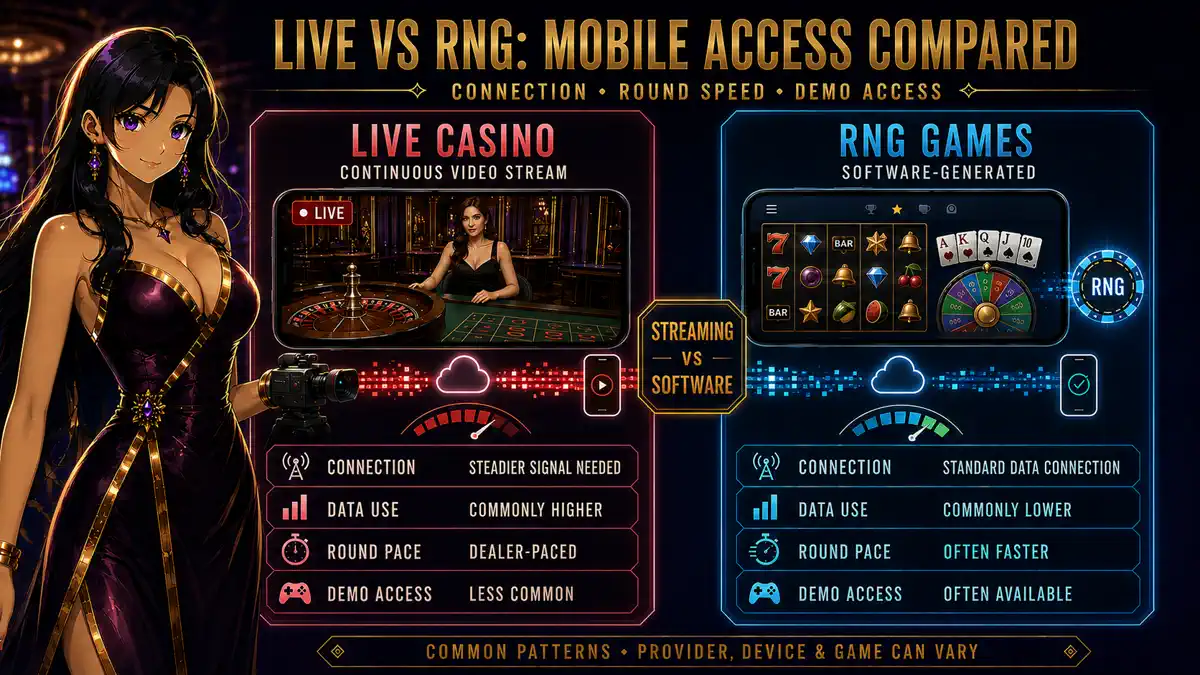
| Mobile data requirements | Normally lower because continuous live video is not required; graphics still use data | Normally higher because video and live table information must be streamed | Use a stable connection and monitor data use, especially for long live sessions |
| Minimum stakes | Often offers a wider range of low digital stakes, depending on the game | Can start higher because tables use defined betting limits and studio capacity, but low-limit tables exist | Never assume; confirm the minimum for the main wager and every side bet before joining |
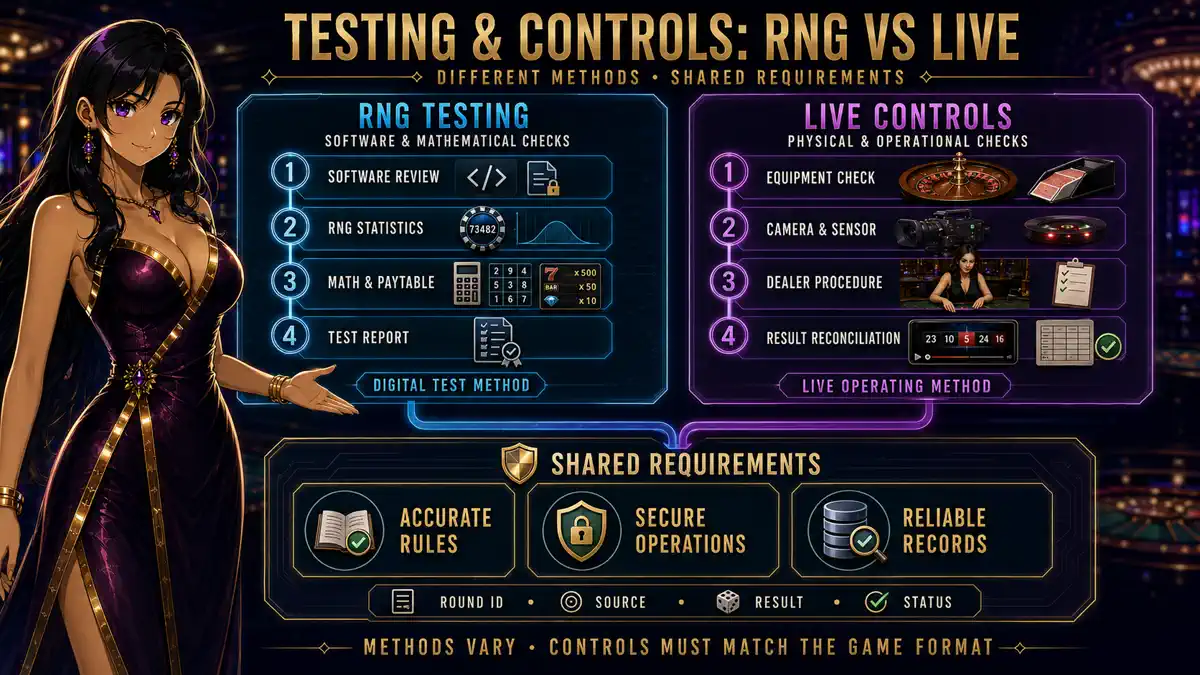
| Auditing and testing | Can include RNG review, source-code checks, game-math verification, result mapping, security and statistical testing | Can include equipment checks, dealer procedures, surveillance, access controls, logs, result capture and statistical monitoring | Look for an authorized platform and independently assessed games rather than judging by appearance |
| Social interaction | Usually limited to the game interface | May include dealer presentation and moderated table chat | Live may feel more social; RNG may feel less distracting |
| Which may suit beginners? | Often useful for demo practice, lower starting stakes, pausing between rounds and learning privately | May suit someone who already knows the rules and values visible dealing, narration and a shared pace | Start with the format that lets you understand every decision without time or spending pressure |
How RNG Casino Game Results Are Produced
An RNG is not a digital dealer that decides whether the player has recently won or lost. It is a mathematical system designed to create values that are sufficiently unpredictable for the game. The game engine then maps those values to the permitted outcomes defined by its rules and paytable.
A simplified digital round contains several steps:
- The player selects a permitted stake or wager.
- The platform validates the request and account conditions.
- The result-generation system supplies a value or sequence.
- The game maps that information to cards, reel positions, dice, numbers or another permitted outcome.
- The rules and paytable evaluate the result.
- The interface displays the animation and the account system records settlement.
The animated spin, deal or wheel is a representation of the round. In many RNG products, pressing a stop button changes only how quickly the result is revealed. It does not allow the player to select an outcome unless the published rules explicitly describe a skill element.
Past independent rounds do not make a future round “due.” Five losing spins do not force the sixth spin to win, and a sequence of red results does not cause black to become more likely on an independent digital Roulette round. Account history must be recorded correctly, but it is not a prediction system.
Our How Online Casino Games Work guide explains RNGs, server-side game processing and testing in more technical detail. Our How Online Slot Games Work guide explains the visible reels, symbols, paylines, ways, clusters, cascades, wilds, scatters and bonus features that appear after a slot result is produced.
How Live Casino Game Results Are Produced
A live table uses a physical event as the principal result source. The player does not handle the equipment remotely. Instead, the dealer follows defined procedures while cameras stream the table and game technology captures the card, wheel or dice result.
A simplified live round commonly works as follows:
- The table opens a timed betting window.
- Players use the digital layout to select a stake and wager.
- Betting closes and the platform rejects late changes.
- The dealer deals cards, spins the wheel or operates other physical equipment.
- The result is identified through approved table procedures and technology.
- The interface displays the outcome and settles eligible wagers under the table rules.
- The table proceeds to the next timed round.
The presence of a person does not remove software from the process. Software still needs to accept wagers, close betting at the correct time, connect accounts to the correct round, display cards or numbers accurately and settle every bet. A fair physical result could still create a dispute if the platform recorded or settled it incorrectly, which is why the complete operation matters.
Live studios also need controls that do not apply in exactly the same form to an RNG screen. These can include trained staff, restricted access to equipment, supervision, camera coverage, documented shuffle or wheel procedures, game logs and processes for handling an interrupted stream or mistaken dealer action.
What happens if the video freezes?
A frozen player-side video does not necessarily mean the physical table stopped. The platform’s interruption and disconnection rules should explain whether an accepted wager remains valid, how the result can be checked and what happens if the studio or result-capture system fails. Do not place a second wager merely because the first result is not visible. Check the round history and support channel first.
Are all live games entirely physical?
No. Classic live Blackjack, Baccarat and Roulette commonly use physical equipment for the primary result, but presenter-led games can add software multipliers, bonus stages or automated devices. Treat these as hybrid products and read how every component is determined.

Human Dealer versus Software Interface
The choice between a human dealer and software is mainly a choice about presentation, interaction and pace. It is not a choice between “real” and “fake” mathematics.
What software-based play offers
- Self-directed rounds: the next round usually waits until the player confirms it.
- Clear prompts: buttons can identify available actions and prevent an invalid choice.
- Private practice: other table participants are not waiting for the decision.
- Compact information: rules, paytables and hand totals can be displayed in the same interface.
- Accessibility options: animation speed, sound and display settings may be adjustable.
What a live dealer offers
- Visible physical procedure: cards and wheels are shown through the stream.
- Human presentation: the dealer announces betting stages and results.
- Shared table rhythm: many participants can place wagers on the same live round.
- Table atmosphere: camera angles, dealer commentary and chat can resemble a casino table.
- Observation: players can watch completed rounds, where permitted, before placing a wager.
A dealer cannot alter the fixed third-card rule in Baccarat or choose a more favorable Blackjack drawing rule for one participant. The displayed table rules control those procedures. Likewise, friendly narration does not change the probability of a Roulette pocket.
Table chat should not be treated as private communication. Do not post account information, contact details, passwords, one-time codes or financial information. Follow moderation rules and remember that the dealer cannot provide individualized financial or legal advice.
Round Speed and Total Wagering Pace
RNG casino games are usually faster because software can produce and settle a result without waiting for physical handling. A new digital Roulette spin or Blackjack hand can often start soon after the previous result. Turbo, quick-spin and autoplay controls can shorten the interval further where available.
Live casino games normally need time for a betting countdown, dealing or spinning, result confirmation and table preparation. This can make each round longer. It does not necessarily make the session low risk: players can still choose large stakes, join several tables or place many side bets during the same round.
Pace changes turnover, the total amount wagered over time. Suppose two versions of the same game have the same theoretical house edge. Completing more paid rounds per hour can increase the amount exposed to that edge, even though the edge per comparable wager has not changed.
For example, placing ₱10 on 20 rounds creates ₱200 of turnover. Placing ₱10 on 100 rounds creates ₱1,000 of turnover. This is not a prediction of the session result; it simply shows why speed matters to spending. An RNG format can be used slowly, and a live format can be used quickly through multiple bets. The player’s behavior remains important.
Beginners should disable optional speed controls and avoid multi-table play while learning. Pause after each round to review the result, not to search for a pattern, but to confirm what the selected wager actually did.
Demo and Free-Play Availability
Demo mode replaces real-money stakes with virtual credits. It is useful for locating controls, reading the paytable, understanding the round order and seeing how the interface reports a result. Demo winnings have no cash value and cannot be withdrawn.
RNG games are more likely to offer free play because one software instance can run a private practice round without occupying a physical table. Many online slots and some digital table games have a demo version. Availability still varies by provider, jurisdiction, device and website.
Live demo play is less common. A studio table has operating costs and a fixed schedule whether or not a viewer wagers. Some platforms let a visitor watch a live table or explore the lobby, but watching is not the same as receiving practice credits and using all betting controls.
A sensible learning sequence
- Read the dedicated rules guide for the game.
- Open an RNG demo of the same general game when available.
- Practise identifying the main wager and settlement.
- Compare the live table’s specific rules with the demo rules.
- Watch at least one live round if observation is permitted.
- Do not join until the betting timer, minimum stake and interface are clear.
Do not assume that an RNG demo and a live table use identical rules. They may differ in decks, payouts, side bets, commissions, wheel pockets or special procedures. Demo results also do not predict later real-money results. Try available demos at CasinoGameOnline.ph Free Games.
Mobile Data and Connection Requirements
Both formats require data, but live casino video normally uses more. Exact consumption cannot be stated as one reliable number because it changes with stream resolution, frame rate, audio, session length, application design and whether the connection repeatedly buffers.
| Mobile consideration | RNG game | Live game |
|---|---|---|
| Continuous video | Usually not required | Central to the experience |
| Connection sensitivity | A drop can interrupt a request or delay the displayed result | A drop can hide the countdown or physical result while the table continues |
| Screen space | Controls can occupy most of the screen | Video, bet layout, history and chat compete for space |
| Battery and heat | Animated graphics can still consume power | Long video sessions can be more demanding |
| Best preparation | Load the rules, test controls and confirm the result history | Use a stable connection, choose appropriate video quality and know the disconnection rule |
Before using a live table on mobile, find the bet-confirmation indicator, table limit, timer, game history and connection rules. Avoid switching networks while a wager is being accepted. If the stream stalls, do not assume the wager disappeared; check the account’s round history.
Use secure networks and keep the device and browser updated. Public Wi-Fi can add privacy and stability risks. Never install a casino application from an advertisement or file-sharing link without verifying the platform and official download source.
Minimum Stakes and Table Limits
There is no universal minimum stake for either format. Limits depend on the provider, operator, table, currency, time and selected wager. A main bet can have one minimum while a side bet has another. The displayed total must be checked before confirmation.
RNG products can often support small stakes across many private game sessions because they do not reserve a physical seat or betting position. This makes digital versions more likely to offer a low-cost practice environment, but it is not guaranteed. Some digital products have high minimums or fixed credit values.
Live lobbies may separate tables into low-limit, standard, VIP, native-language or provider-specific groups. A shared table can accept many participants, yet its operational format and market position may lead to a higher minimum. Low-limit and unlimited-seat live tables also exist, so “live always costs more” is too broad.
Check these amounts before joining
- Table minimum: the smallest total or qualifying main wager accepted for the round.
- Table maximum: the largest permitted amount, which may differ by bet type.
- Side-bet minimum: a separate threshold for optional wagers.
- Chip or credit value: the value represented by each on-screen unit.
- Total confirmed stake: the combined amount charged when several positions or side bets are selected.
- Commission or fee: any stated deduction or separate charge attached to the chosen format or wager.
A low minimum is not an invitation to play more rounds. Session cost depends on stake multiplied by the number of wagers, adjusted for any returns. A fast low-stake RNG game can create more turnover than a slower live table if many rounds are completed.
Auditing, Testing and Game Integrity
RNG and live games need different controls because their result sources differ. A credible assessment considers the full system instead of looking for one badge or assuming that a camera proves fairness.
| Integrity area | RNG casino game controls can include | Live casino game controls can include |
|---|---|---|
| Result source | Algorithm design, seeding, unpredictability and statistical output review | Card, wheel, dice and equipment quality plus procedures for use |
| Game mathematics | Mapping values to results, paytable implementation, RTP and house-edge calculations | Rules, payouts, commissions, wheel configuration, deck procedure and side-bet settlement |
| Operations | Software access, change control, platform security and transaction logging | Dealer training, supervision, restricted studio access and equipment custody |
| Evidence | Round records, account transactions and reproducible test results | Video surveillance, game logs, shoe or wheel records and captured results |
| Ongoing monitoring | Statistical analysis, incident review, version control and security monitoring | Statistical table analysis, equipment checks, dealer-error review and procedure audits |
| Interruptions | Rules for incomplete requests, disconnections and recovery | Rules for stream loss, mistaken deals, equipment failure and void rounds |
The UK Gambling Commission’s technical standards illustrate the distinction. Its RNG standards address acceptably random and unpredictable outcomes and correct result mapping. Its live-dealer standards address physical equipment, trained dealers, supervision, surveillance, access control, game logs and statistical monitoring. Other jurisdictions apply their own requirements, so a standard from one regulator does not authorize a website in another market.
Independent laboratories can assess RNGs, game mathematics, platforms, mobile products, security and live-dealer systems. A test report is meaningful only when it applies to the exact provider, version and system being used. A copied laboratory logo does not prove that a website or every game on it has been tested.
Players should also be able to access the game rules, how a winning result is determined, relevant payouts and available mathematical information before wagering. If these are missing, unclear or inconsistent with settlement, stop and seek clarification.
Blackjack, Baccarat and Roulette Examples
The clearest way to understand the format difference is to compare the same game family across digital and live versions. In every example, the variant can matter more to the mathematics than the delivery method.
RNG Blackjack vs Live Blackjack
Digital Blackjack uses software to deal a permitted hand and can provide instant action buttons. Live Blackjack streams physical cards and uses a table countdown. Both can offer Hit, Stand, Double, Split and other actions, but the exact options depend on the rules.
Compare the natural Blackjack payout, number of decks, whether the dealer hits or stands on soft 17, doubling restrictions, split rules and surrender availability. A 3:2 table and a 6:5 table do not have the same main-game return, regardless of whether the cards are digital or live.
Read our complete How to Play Blackjack Online guide for card values, hand types, actions, dealer rules, insurance and beginner examples.
RNG Baccarat vs Live Baccarat
Digital Baccarat generates and displays the cards through software. Live Baccarat streams a dealer working with physical cards or a shoe. In both formats, the Player and Banker hand labels do not identify the person playing, and the third-card procedure is automatic.
Compare the Banker commission or no-commission rule, Player and Banker payouts, Tie payout, side bets, deck or shoe procedure and any special handling of a Banker total. A live stream does not make the Tie bet equivalent to the Banker bet.
Read our complete How to Play Baccarat Online guide for card values, natural totals, third-card rules, commissions and sample rounds.
RNG Roulette vs Live Roulette
RNG Roulette maps a software-generated result to a digital wheel pocket. Live Roulette uses a physical wheel and ball. Both settle inside and outside bets from the winning pocket, subject to the table’s rules.
The number of pockets is a major mathematical difference. A common European wheel has one zero, while a common American wheel has zero and double zero. That distinction changes probabilities even if both tables are live, and it normally matters more than whether the wheel is streamed or rendered.
Read our complete How to Play Roulette Online guide for inside and outside bets, standard payouts, probabilities, wheel variants, myths and demo play.
What about slots and poker?
Online slots are usually RNG games because the software selects reel or grid results. A presenter-led wheel with bonus mechanics may look slot-like, but it is a separate live or hybrid format with its own rules.
Online poker rooms do not fit this comparison neatly. Software can shuffle and deal digital cards, but participants compete against one another rather than against a fixed casino paytable. Live casino poker variants may instead be house-banked. Use our How to Play Poker Online guide to distinguish Texas Hold’em, cash games, tournaments and casino-style poker products.
RTP and House Edge: Does the Format Matter?
Neither format automatically has better odds. The mathematical return comes from the exact rules, number of possible results, payouts, fees and player decisions where applicable.
Consider three examples:
- A single-zero Roulette game and a double-zero Roulette game have different probabilities because the wheels contain different numbers of pockets—not because one is live.
- A Blackjack game paying 3:2 for a natural and one paying 6:5 use different payouts—not because one uses an RNG.
- A Baccarat table charging commission on a winning Banker wager and a no-commission variant can settle differently—not because a human dealer is visible.
Return to Player (RTP) is a theoretical long-run percentage under the stated game assumptions. House edge is the average mathematical advantage built into the corresponding wager, often expressed as 100% minus RTP when the measures use the same basis. Neither predicts what one player will receive in a short session.
Live and digital versions can share a theoretical return when they use equivalent rules and correct implementation. They can also differ because of rule choices, side bets, commissions, fees or strategy assumptions. Compare the published information instead of comparing the camera with the animation.
Our Return to Player and House Edge guide explains theoretical return, sample size and why short sessions diverge. Our Casino Game Volatility and Variance guide explains why payout frequency and session swings can differ even when long-run return is similar.
Which Format May Suit Beginners?
There is no single best format for every beginner. The useful question is: Which environment gives this person enough time and information to understand the rules without spending pressure?
RNG games may be a better starting point when you want to:
- use demonstration mode and virtual credits;
- start with a smaller stake where the game permits it;
- pause between rounds without a table countdown;
- learn privately without chat or other participants;
- use less mobile data than a continuous video stream;
- repeat the interface sequence slowly; or
- review prompts, totals and result explanations on one screen.
Live casino games may suit a beginner who:
- already understands the basic rules and main wagers;
- prefers seeing physical cards, a wheel or dice;
- finds dealer announcements helpful;
- values a shared table rhythm and social presentation;
- has a stable connection and sufficient data;
- can make decisions comfortably before the timer closes; and
- has checked the minimum stake and exact variant first.
Live play can look slower, but the betting window may still feel rushed. Do not let a countdown push you into a wager you do not understand. Missing a round costs nothing; placing an unplanned wager can.
A practical route is to learn the rules in an article, practise on a matching RNG demo, then observe a live table before deciding whether that presentation adds value. Staying with demo mode is also a complete and valid outcome.
Beginner Selection Checklist
- Name the exact game: “Live casino” is a format; identify whether the game is Blackjack, Baccarat, Roulette or something else.
- Check the variant: confirm the wheel, deck, payout, commission, drawing rule or paytable.
- Find the result method: read whether the result comes from an RNG, physical equipment or a hybrid component.
- Use demo mode where available: learn controls with virtual credits before considering real-money play.
- Compare minimums and total stake: include side bets and multiple betting positions.
- Test the device and connection: live streams need stable video and readable controls.
- Understand the timer: know when betting closes and how decisions are confirmed.
- Read the interruption rule: learn what happens if the game or connection fails.
- Verify the platform: use current official regulatory sources rather than copied logos or advertisements.
- Set money and time limits first: do not increase speed or stakes to recover a loss.
A simple beginner decision
Choose an RNG demo first if you still need to learn the rules or buttons. Consider observing a live table if you know the rules and want to see the physical process. Do not play either format for money if the stake, payout, timer or settlement is unclear.
Common Myths and Comparison Mistakes
Live games always have better odds
A camera and physical table do not determine the house edge. Rules, payouts, fees and bet type do. Compare the exact variant.
RNG games can react to one player’s losses
A properly implemented RNG game produces unpredictable results under its approved rules. Recent wins or losses do not make a future independent result due. Platform authorization and testing still need to be verified.
A visible dealer makes testing unnecessary
Live operations require controls for physical equipment, dealer procedures, access, surveillance, result capture, settlement and records. Visibility is useful presentation, not a substitute for oversight.
Live games do not use software
The physical event may create the main result, but software accepts bets, manages timers, associates wagers with rounds, displays information and settles accounts.
Choosing by the recent-results board
Roadmaps and spin histories describe past outcomes. They do not predict the next independent deal or spin and cannot create a profitable staking system.
Assuming two versions share the same rules
An RNG Blackjack demo and a Live Blackjack table can have different payouts and dealer rules. The same applies to Baccarat commission and Roulette wheel type. Recheck every version.
Checks for Players in the Philippines
A polished application, live video stream or laboratory logo does not by itself establish that an online gaming website is authorized in the Philippines. Fraudulent pages can copy names, logos, certificates and game streams.
- Verify the exact website: use the PAGCOR Guarantee authorized-platform verification service instead of relying on an advertisement or logo.
- Check age and eligibility: PAGCOR’s public responsible-gaming information states that gaming is for people aged 21 and above and lists additional restricted persons.
- Confirm the game: read the provider, title, version, rules, result method, payout information and limits.
- Protect the account: never share a password, one-time code or payment credential with a dealer, chat participant or unsolicited support account.
- Use responsible-gaming tools: set spending and time limits and use exclusion or support options when needed.
PAGCOR's Responsible Gaming page provides current information about restricted persons and exclusion measures. Regulations and authorized-site lists can change, so verify them directly before taking action.
Casino games carry a financial risk in either format. Do not borrow to gamble, chase losses or use money needed for food, housing, healthcare, education, debt or other essential expenses. Stop if play is affecting sleep, work, relationships or emotional wellbeing.
Experience Live Dealer & RNG Casino Games Online
Explore licensed Philippine online casino portals offering high-definition live streaming tables, RNG slot classics, and fast GCash & Maya cashouts.
Frequently Asked Questions
What is the difference between live casino games and RNG games?
RNG casino games use software algorithms to generate unpredictable outcomes mapped to cards, reels, or wheels. Live casino games stream physical equipment operated by human dealers or presenters in real time while an online interface records bets and processes payouts.
Are live casino games fairer than RNG games?
Neither format is inherently fairer. Both delivery systems depend on regulatory oversight, independent testing, and integrity controls. RNG games undergo mathematical code auditing, while live tables undergo equipment checks, studio surveillance, and statistical monitoring.
Do live casino games use an RNG?
Classic live dealer games generate primary outcomes physically through real cards or wheels. However, some hybrid game-show formats incorporate secondary software RNGs for random multipliers or bonus mini-games.
Which is faster: live casino or RNG games?
RNG games are generally faster because software resolves rounds instantly without physical dealing or dealer timers. Live casino games operate at a fixed table pace governed by betting countdowns and physical game handling.
Can I play live casino games in demo mode?
Free demo mode is rarely available for live dealer games due to continuous studio operational costs. RNG digital games frequently offer free demo play with virtual practice credits.
Do live casino games use more mobile data?
Yes. Streaming continuous high-definition video for live dealer tables consumes significantly more mobile data and bandwidth than standard digital RNG games.
Do RNG games have lower minimum stakes?
RNG games often feature lower minimum stakes because software instances can serve unlimited private sessions at minimal server cost. Live tables often have slightly higher minimums to cover studio overhead, although low-limit live tables do exist.
Does live Roulette have better odds than RNG Roulette?
No. The odds in Roulette are determined by wheel layout (European single-zero vs. American double-zero) and table rules, not whether the wheel is physical or digital. A European RNG wheel and a European Live wheel share the exact same 2.70% house edge.
Which format is better for casino game beginners?
Beginners often benefit from starting with RNG demo games to learn rules, bet controls, and paytables at their own pace without timer pressure. Once familiar with game mechanics, players can transition to live dealer tables if they prefer the social atmosphere and visible dealing process.
How can players in the Philippines check an online casino website?
Filipino players should verify site licensing against PAGCOR's official portal list of authorized online platforms, confirm age eligibility (21+), review game paytables and testing credentials, and practice responsible bankroll management.
The Bottom Line
Live casino games use streamed physical equipment and a human dealer or presenter. RNG casino games use software to generate and display a valid unpredictable result. RNG versions are commonly faster, lighter on mobile data and more likely to have demo mode. Live versions provide visible physical procedures, narration and a shared table pace.
The format does not decide which game has better odds. Compare the exact variant, rules, payout, commission, wheel, deck procedure, side bets, table limits and fees. Beginners will often learn more comfortably in a free RNG demo before observing a live table. Whichever format is used, verify the platform, understand the full stake and set strict money and time limits.
Sources and Further Reading
- UK Gambling Commission RTS 3 — game rules, payouts and likelihood information
- UK Gambling Commission RTS 5 — result determination, settlement and monitoring
- UK Gambling Commission RTS 6 — play-for-free game representation
- UK Gambling Commission RTS 7 — generation of random outcomes
- UK Gambling Commission RTS 17 — live-dealer studio equipment, staffing, surveillance and logs
- UK Gambling Commission — live-dealer return monitoring and physical-game controls
- Gaming Laboratories International — iGaming testing for RNGs, game math, platforms, mobile and live-dealer systems
- PAGCOR Responsible Gaming
- PAGCOR Guarantee authorized online gaming websites
Responsible gaming: Live and RNG casino games involve financial risk. No format, dealer, RNG, strategy, trend or staking pattern guarantees a profit. Set time and spending limits, never chase losses, never borrow to gamble and do not use money required for essential expenses. Participation is for eligible adults only.